Brahma Overpowered by Kama (Sexual Urge) and the Birth of Lauhitya
Within the sacred verses of Hindu scriptures, the Puranas offer profound allegories about human nature, cosmic duties, and the overwhelming forces that govern the universe. One such captivating narrative is the Brahma and Amogha story found within the Padma Purana. This specific legend serves as a powerful reminder of how Kama (sexual urge) holds an absolute, inescapable grip over all living entities—stretching from mortal humans to the highest gods of the Hindu pantheon. Ultimately, this divine encounter leads to the manifestation of the Lauhitya Tirtha, the sacred origins of the Brahmaputra River.
The Flawless Virtue of Amogha
The narrative begins by introducing Amogha, the young, exceptionally beautiful, and deeply devoted wife of a highly spiritually advanced sage named Shantanu. Amogha was the epitome of a pativrata—a woman completely anchored in righteousness, purity, and devotion to her husband. Together, the couple lived a peaceful, ascetic lifestyle in their quiet forest hermitage. One morning, Sage Shantanu left the hermitage to venture deep into the forest to gather fresh flowers for his daily Vedic rituals. It was during his absence that Lord Brahma, the creator of the universe, descended to the hermitage, searching for the wise sage.
The Irresistible Power of Kama Over Brahma
Padma Purana - Pages 731-732
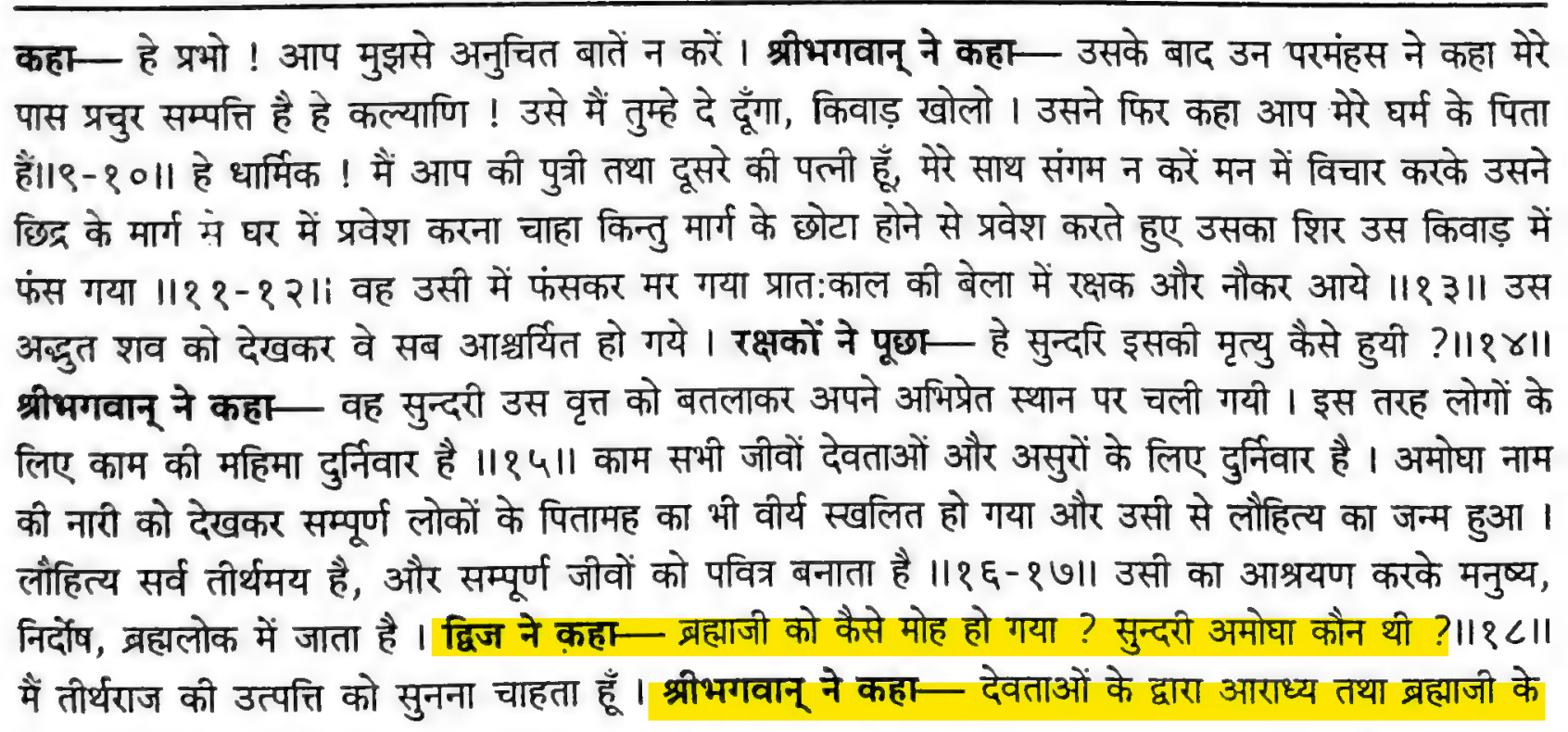
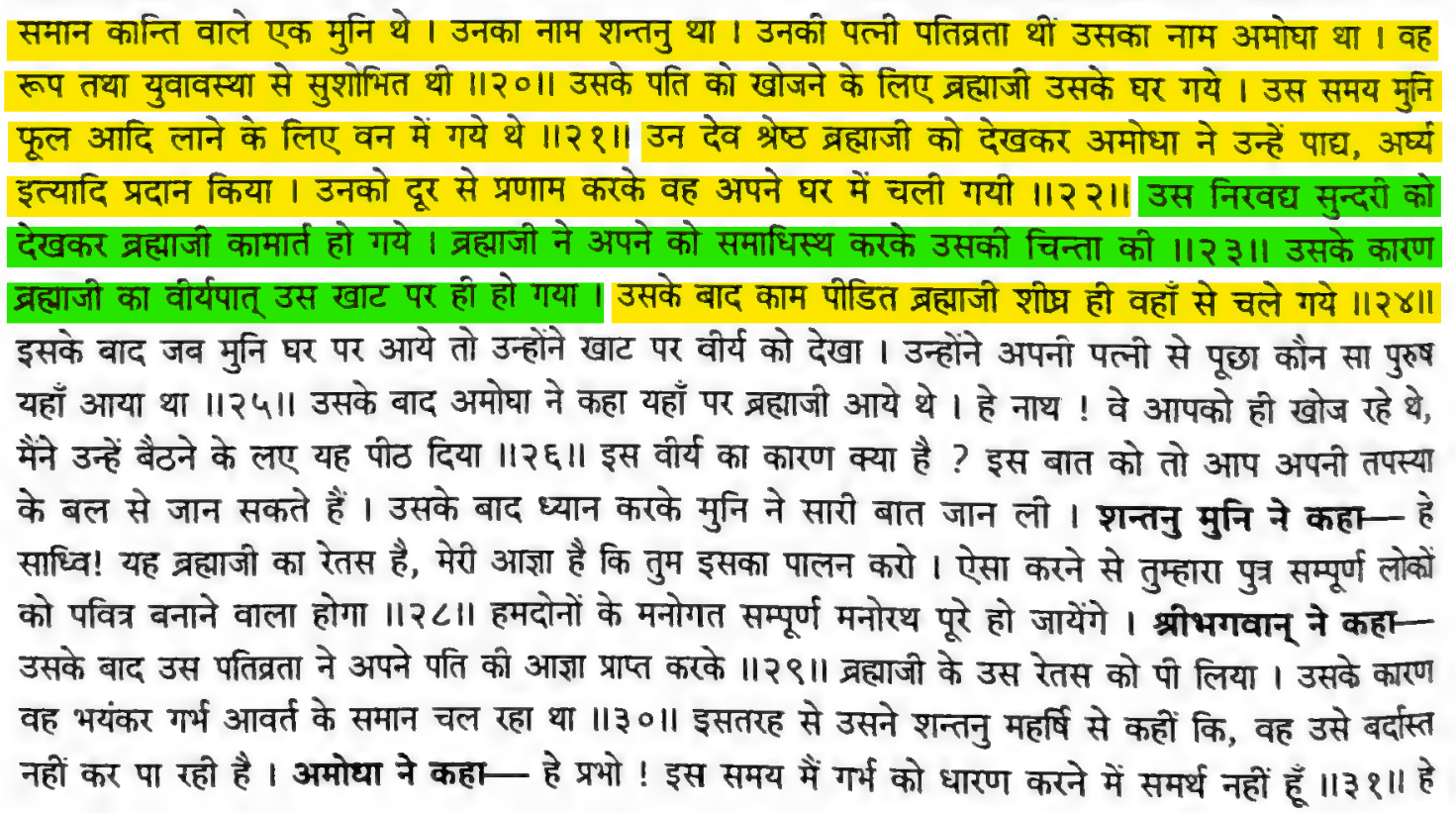
Upon Brahma's arrival, Amogha stepped forward to fulfill her duties as a flawless hostess. Recognizing the supreme deity, she respectfully offered him the traditional hospitality rites, providing Padya (water to wash the feet) and Arghya (offerings to an honored guest). Out of modesty and profound respect for Brahma, she kept her distance, bowing to him from afar before retreating inside. However, the brief glimpse of Amogha’s radiant, flawless beauty completely overwhelmed Lord Brahma. Stricken by sudden, intense desire (Kamarta), Brahma tried desperately to master his mind. He attempted to enter a state of deep meditation (Samadhi) to suppress the surging emotion, but his self-control failed under the sheer weight of Kama. Overpowered by intense sexual urge, his divine life force (veerya) fell onto the sage's cot. Filled with immense shame, regret, and mental agitation, Brahma hastily fled the hermitage.
Sage Shantanu’s Divine Insight
When Sage Shantanu returned from the forest, he immediately noticed the unusual substance on the cot and questioned his wife about what had transpired during his absence. Amogha answered him with complete transparency and pure intent. She explained that Lord Brahma had visited looking for him, and that she had merely offered him a seat out of respect before withdrawing. Confused by what had happened next, she told her husband:
"The true reason behind this occurrence can only be known by the power of your own tapas (ascetic meditation)."
Sage Shantanu sat in quiet meditation, projecting his consciousness to uncover the truth of the event. Realizing exactly what had happened, he harboured no anger toward his virtuous wife, nor did he seek vengeance against Brahma. Instead, he recognized a higher cosmic destiny at play. He understood that Brahma's divine essence was destined to bring forth a powerful entity into the world. He turned to Amogha and commanded her to nurture this divine energy, promising that the resulting child would purify all the worlds. Out of absolute devotion to her husband's word, Amogha obeyed.
The Cosmic Burden and the Birth of Lauhitya Tirtha
Consuming the life force of Brahma proved to be an agonizing ordeal for a mortal frame. Inside Amogha’s womb, the divine essence felt like a violent, raging whirlpool of cosmic energy. As the pregnancy progressed, the heat and weight became entirely unbearable. Desperate and physically exhausted, Amogha pleaded with her husband, explaining that she could no longer endure the terrifying strain of carrying the child. The Padma Purana concludes this extraordinary tale by celebrating the birth of Lauhitya (the sacred entity manifesting geographically as the Brahmaputra River). Born of Brahma's pure creative energy and nurtured by the unparalleled virtue of Amogha, Lauhitya became a supreme Tirtha (holy water body). The texts extol its waters as containing the spiritual power of all holy places combined. According to the Puranic promise, anyone who seeks refuge in or bathes in the sacred waters of Lauhitya is instantly absolved of all sins and ascends directly to Brahmaloka—the faultless, eternal realm of the creator.
Moral Conclusion: The Inescapable Power of Kama
The narrative of Brahma and Amogha in the Padma Purana carries a profound psychological and spiritual lesson. In mainstream theology, Lord Brahma is the supreme architect of the universe—a cosmic entity overflowing with wisdom, virtue, and spiritual power. Yet, this story intentionally strips away that untouchable divine exterior to reveal an unsettling truth: even the creator of the universe is vulnerable to the agonizing grip of Kama (sexual desire).
Brahma's desperate, failed attempt to enter Samadhi (deep meditation) to fight his urges shows that raw lust cannot simply be ignored or suppressed by intellect alone. It acts as a humbling cosmic reminder to seekers. If the creator of the three lokas can be completely blinded and overpowered by desire beyond his control, ordinary mortals do not stand a chance.
God Kabir says:
विकार मरे ना जानियो, ज्यों भूभल (भोभा) में आग।
Vikar mare na janiyo, jyon bhubhal (bhobha) mein aag
God Kabir warns us that human vices (sexual urge, anger, greed, pride, attraction) work exactly like that buried fire. Sometimes, we feel we have conquered our flaws or that we have become completely calm and holy. But God Kabir warns us never to lower our guard. The desires are not dead; they are just dormant.
In Bhagavad Gita 6:34, Arjuna raises a similar doubt with the speaker of Gita that, "The mind is restless, turbulent, obstinate, and very strong, O Krishna. To tame it, I think, is as difficult as controlling the wind." On this the speaker of Gita agrees and says in 6.35, "Without a doubt, O mighty-armed son of Kunti, the mind is restless and difficult to curb. But it can be conquered by Abhyasa (Practice) and Vairagya (Detachment)." However you can see in the above case that Brahma (one of the supreme deities of the 3 lokas) was completely unable to conquer his mind despite practice and detachment.
God Kabir warns of a higher force called "Kaal" who controls everything. This is the speaker of Bhagavad Gita. He himself says in gita 7.10 that, "O Partha, know Me to be the eternal seed of all existences. I am the intellect of the intelligent, and the splendor of the glorious." thus proving that we all, including Brahma, Vishnu and Shiva are controlled by a higher power called Kaal. Only a Satguru (a True Guru) can break the shackles of Kaal and free a soul from his trap.
Padma Purana has other fascinating stories too. Read about the tale of Shiva related to Kshemankari Devi. Visit the repository of tales from the Purans.
Ref:
Frequently Asked Questions (FAQ Section)
1. What is the story of Brahma and Amogha in the Padma Purana?
The story details how Lord Brahma visited the hermitage of Sage Shantanu and became completely overwhelmed by the beauty of the sage's wife, Amogha. Stricken by uncontrollable desire (Kama), Brahma lost his self-control, and his divine life force fell onto a cot. This energy was later nurtured by Amogha, leading to the birth of the sacred Lauhitya Tirtha (Brahmaputra River).
2. Who is Amogha in Hindu mythology?
Amogha was the exceptionally beautiful and highly virtuous wife of Sage Shantanu. She is celebrated in the Padma Purana as a devoted pativrata (a righteous wife) whose pure conduct and obedience to her husband helped manifest one of India's most sacred rivers.
3. What is the mythological origin of the Brahmaputra River?
According to the Padma Purana, the Brahmaputra River is mythologically known as Lauhitya. It was created from the divine essence of Lord Brahma after he succumbed to desire for Amogha. Because it carries the potent creative energy of Brahma and the purity of a virtuous woman, it is considered a supreme pilgrimage site (Tirtha).
Related Topics
- Meat Eating Prohibited for Seekers of Heaven - Skanda Purana
- The Equine Romance of Surya Dev: How the Twin Ashvini Kumars Were Born - Markandeya Purana
- Brahma's Infatuation towards his own Daughter - Matsya Purana
- The Legend of Brahma and Amogha: Padma Purana
- The Day Goddess Parvati Caught Shiva: The Untold Legend of Kshemankari Devi - Padma Puran
- Devi Purana
- Shiv Purana
- Markandeya Puran
- Kurma Purana
- Padma Purana
- Skanda Purana
- Brahm Purana
- Bhavishya Purana
- Brahma Vaivarta Purana
- Bhagavata Purana or Shrimad Bhagavatam
- Why Did Rama Reject Sita? Decoding Yuddha Kanda in the Valmiki Ramayana
- Wine and Meat in the Ramayana? What Valmiki Wrote About Rama and Sita
- Brahma, Vishnu and Shiva Are Mortal - Kurma Purana - The Supreme God Is Kavi (Kavir Dev)
- Origin of Shiva, Vishnu, Brahma, and the Supreme Truth - Shiv Purana
- The Story Behind Shiva’s Phallic Form (Shivling) - Shiv Purana
- Why Did Lord Brahma Lose His Fifth Head - Shiv Purana
- The Bhasmasura Episode - Shrimad Bhagavatam
- King Parikshit and the Five Abodes of Kali Yuga - Shrimad Bhagavatam
- The Ordeal of Anusuya and the Conduct of Brahma, Vishnu, Shiva - Bhavishya Purana
- Kartikeya’s Birth in the Brahm Vaivarta Purana
- The Tulsi–Vishnu Narrative - Brahma Vaivarta Purana
- How did the Universe Originate - Devi Bhagavad Purana
- The Tale of the Hidden Kshar Brahm - Devi Bhagavat Purana
- The Cosmic Battle of Madhu and Kaitabha - Devi Bhagavata Purana
- The Mystery of two Brahma, Vishnu and Shiva - Devi Bhagavata Purana
- Vishnu, Shiva, and Brahma Realize Their Dependence on Goddess Durga - Devi Bhagavata Purana
- The Divine Marriages of Brahma, Vishnu, and Shiva — Devi Bhagavata Purana
- The Real Purpose of Pilgrimage - Devi Bhagavata Purana
- Teachings of Brihaspati and Shukracharya - Devi Bhagavata Purana
- The Story of Sage Ruchi - Markandeya Purana
- The Story of Sage Markandey and Indra: A Scriptural Warning Against Temporary Heavenly Pleasures
- The Controversial Shraddha Teachings of Queen Madalasa - Markandeya Purana
- Pururava Pilgrimage - Brahm Purana
- The Controversial Feast of Lord Shiva - Padma Purana
