The Unvarnished Ramayana: The Raw Truth Behind Rama’s Rejection of Sita in the Assembly
In the sanitized versions of the Ramayana popular in modern television and children's books, the reunion of Sri Rama and Sita after the fall of Lanka is often painted as a moment of pure, uninterrupted joy. The subsequent Agni Pariksha (ordeal by fire) is frequently soft-pedaled as a mere formality—a gentle, pre-planned demonstration to satisfy public doubt while Rama and Sita remain perfectly aligned in private affection. However, a direct, verbatim reading of the ancient source text—the Valmiki Ramayana (Yuddha Kanda, Sargas 115–116)—reveals a scene that is far more raw, devastating, and psychologically complex.
The original verses paint an agonizing picture: a hero torn apart by public duty, a king delivering words that cut like glass, and a proud, chaste woman shattered in front of an entire army of monkeys and demons.
The Literal Scene: A Devastating Welcome
According to the text, when the princess of Mithila is finally brought before Rama after a grueling year of captivity, she stands before him with deep humility and hope. Instead of open arms, she is met with a cold, formal address delivered before a massive, crowded assembly. Rama systematically strips away any romantic notions regarding the war he just fought:
Not For Love, But For Honor: Rama explicitly tells Sita that the massive casualties, the leaping of the ocean by Hanuman, and the alliance with Sugriva were not undertaken out of a personal desire to win her back. He states clearly: "This strenuous exertion of war... was not undertaken for your sake. This was done by me to protect right conduct, to dispel public scandal, and to wipe away the blemish cast upon my highly renowned lineage." (Verses 15–16)
The Unbearable Sight: Rama compares the very sight of Sita to an agonizing physical affliction: "A suspicion has arisen regarding your character... Just as the light of a lamp is unbearable to one suffering from an eye disease, you appear highly displeasing to my sight today." (Verse 17)
A Cruel Ultimatum: He formally severs their tie and tells her she is free to go anywhere in the ten directions. He goes so far as to suggest she seek shelter, remarriage, or protection under his younger brothers (Lakshmana or Bharata), the monkey king Sugriva, or even the demon Vibhishana: "Fix your mind wherever you find happiness." (Verses 18, 22–23)
The Ultimate Insult: Rama voices the darkest public suspicion aloud, questioning how a lustful demon like Ravana could have kept a woman of divine beauty in his palace for a year without violating her. (Verse 24)
The text concludes this passage with a tragic image: Sita, a proud noblewoman who had never heard a harsh word in her life, collapses into tears, looking like a delicate flowering vine completely crushed and shattered by the heavy trunk of a wild elephant. (Verse 25)
Hard Inferences: Decoding the Psychological and Societal Realities
When we step away from modern theological sanitization and read Valmiki's words exactly as they were written, several profound and heavy conclusions emerge about the characters, cosmic law, and the burdens of ancient leadership:
1. The Agonizing Split: The Man vs. The King
Verse 11 provides a crucial psychological anchor for this entire sequence: "She was the beloved of her lord's heart... yet, due to the fear of public scandal and gossip, King Rama's heart was torn in two." This indicates that Rama was not acting out of personal malice or a lack of love. Instead, he was entirely enslaved by his role as the ideal king (Raja Dharma). In the ancient ethos, a king's reputation had to be entirely spotless to maintain structural order over society. Rama sacrificed his personal happiness and his wife’s feelings on the altar of public perception. His heart was "torn in two," proving that the burden of being a perfect ruler requires a brutal, almost robotic suppression of personal love.
2. The Absolute Cruelty of Ancient Patriarchy and Public Gossip
The passage highlights a grim sociological reality of the ancient world: a woman’s virtue was treated as public property, subject to the casual gossip of the masses (Janavada). Even though Sita was the victim of a violent abduction, the societal gaze blamed her for being held in another man's house and subjected to an evil gaze. Rama’s harsh words reflect the rigid, unyielding, and often cruel standards of the Ikshvaku lineage, where ancestral honor (Kula) mattered more than individual justice or trauma.
3. Sita’s Powerlessness in the Face of Structural Honor
Sita’s reaction—compared to a vine shattered by an elephant's trunk—underlines the absolute vulnerability of an innocent person caught in the machinery of statecraft. She survived a year of psychological torture in the Ashoka Vatika, maintaining her chastity through sheer willpower, only to return to a husband who felt compelled by politics to publicly humiliate her. Her weeping is not just out of sadness; it is the profound shock of a proud, highly virtuous woman realizing that her moral purity is being treated as a political inconvenience.
4. The Raw Realism of the Itihasa Tradition
Unlike later devotional literature (like the Ramcharitmanas) which went to great lengths to shield Rama from flaws by introducing a "shadow Sita" (Maya Sita) to take her place in Lanka, Valmiki’s original text treats its characters with stark, psychological realism. It shows that ancient heroes faced messy, heartbreaking dilemmas where there was no easy, happy choice. Rama chose the state over his wife, and the text does not hide the devastating human cost of that choice.
Conclusion
This literal text from the Valmiki Ramayana serves as a powerful reminder that ancient epics were not written to be simple, comfortable bedtime stories. They were profound explorations of duty, sacrifice, and the heavy price individuals pay when cosmic responsibilities collide with human emotion.
Images - Valmiki Ramayana
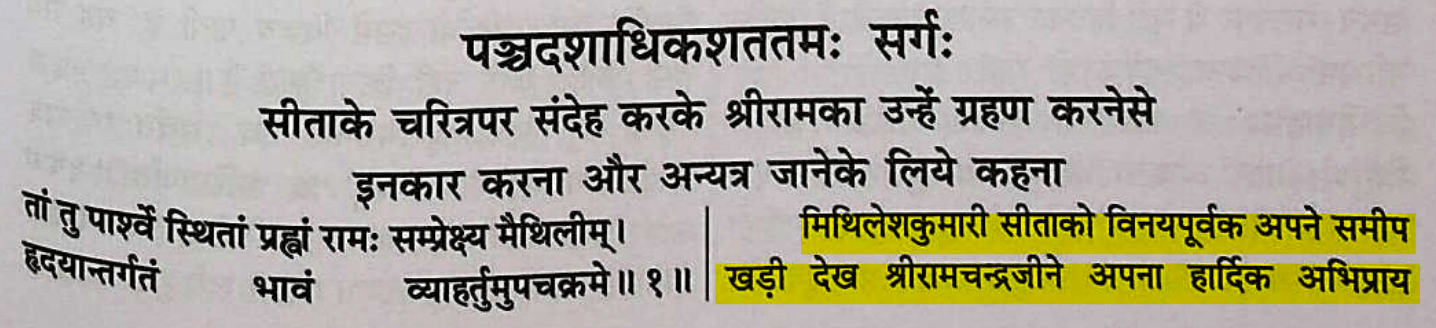
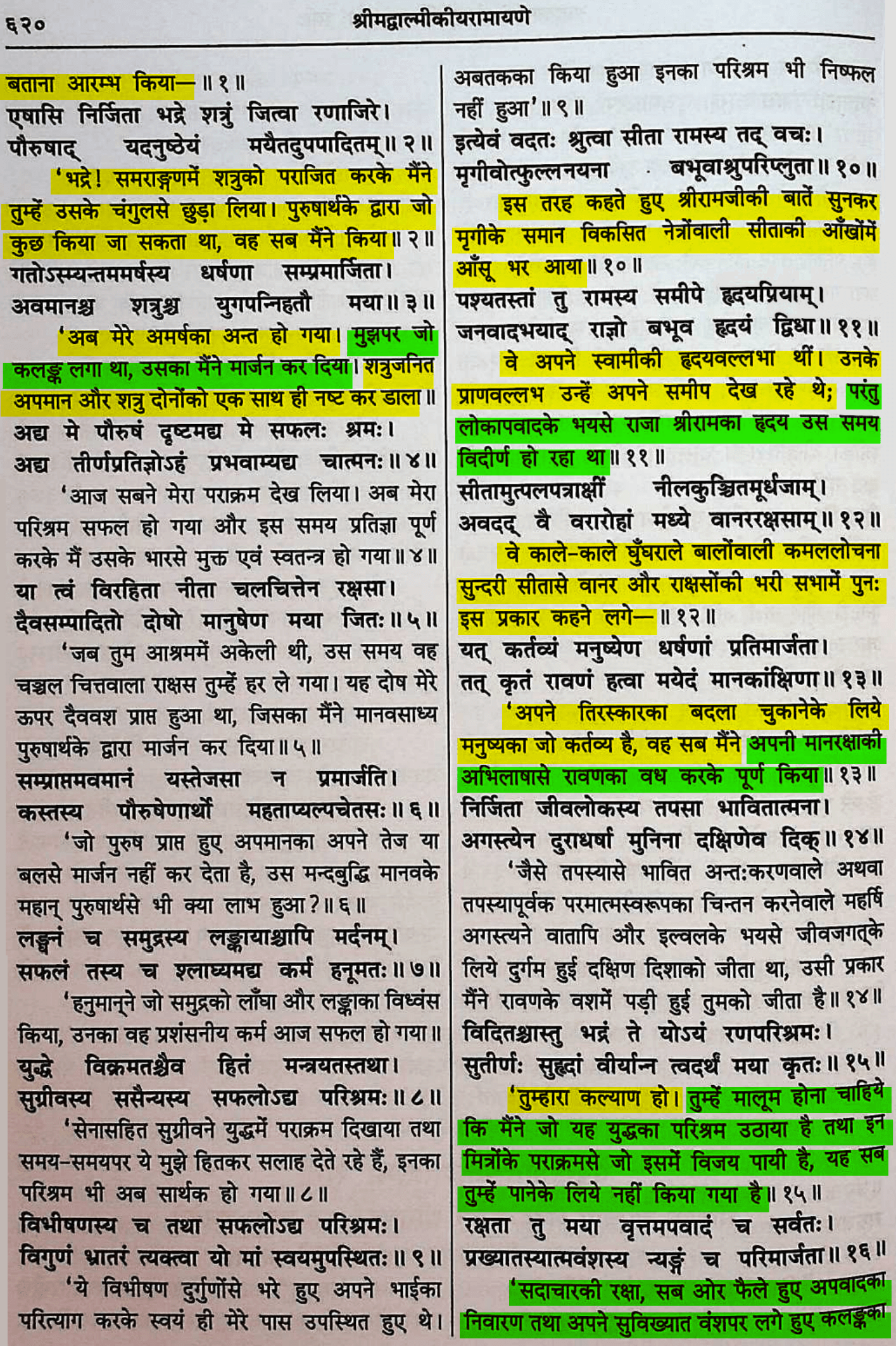
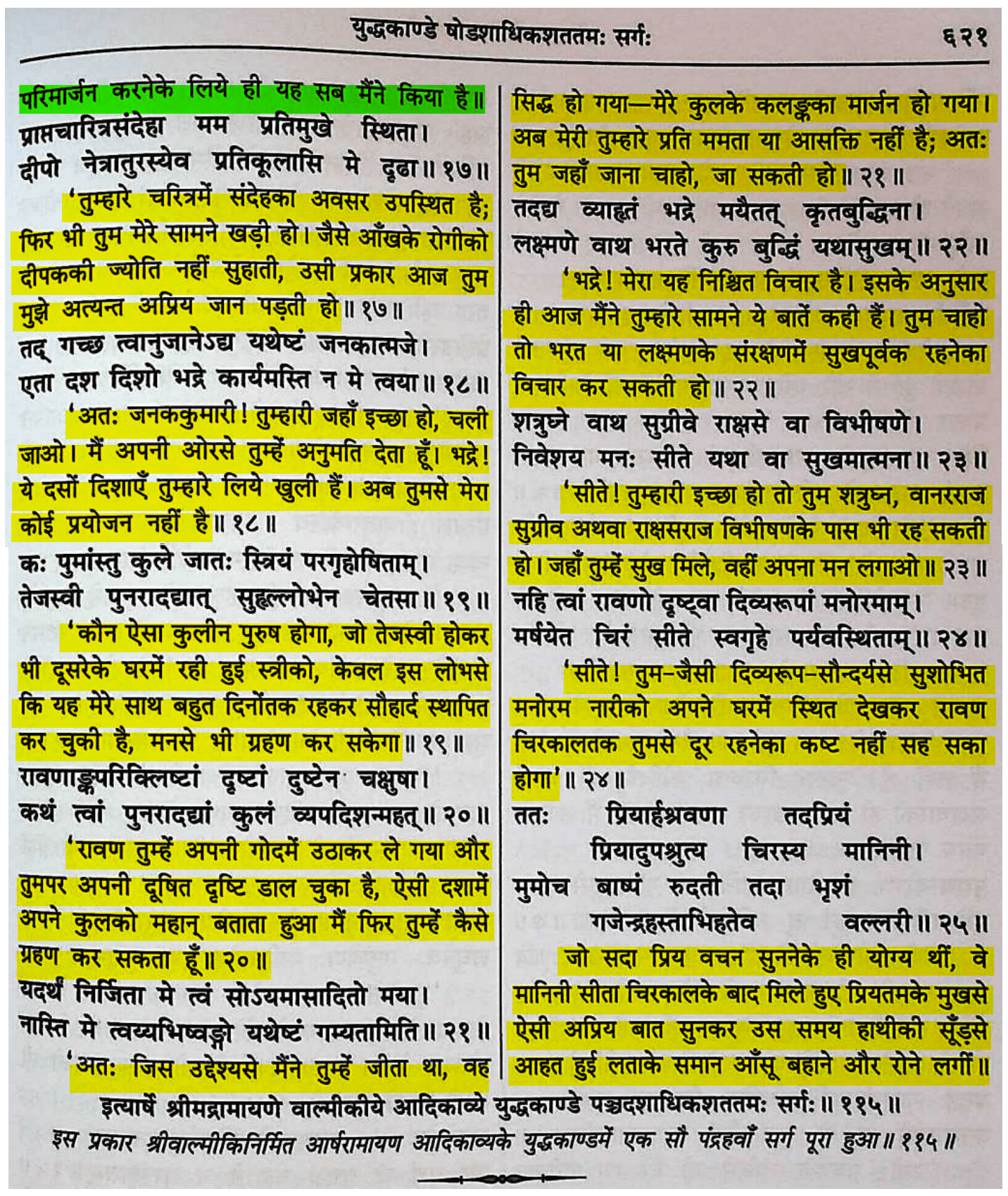
This text is from the Yuddha Kanda (Book of War) of the Valmiki Ramayana. It covers the end of Sarga 115 and the entirety of Sarga 116. The section describes the intense and painful moment when Sri Rama, standing before the gathered assembly of monkeys and demons, addresses Sita after her rescue, expressing his doubts about her chastity due to her captivity in Ravana's palace and telling her she is free to go wherever she wishes.
Below is the complete, direct English translation of the Sanskrit verses along with the corresponding Hindi commentary provided in the images.
Image 1: Sarga 115 Chapter Header & Verse 1
Chapter Title:
- Hindi: सीताके चरित्रपर संदेह करके श्रीरामका उन्हें ग्रहण करनेसे इनकार करना और अन्यत्र जानेके लिये कहना।
- English: Sri Rama doubting Sita's character, refusing to accept her, and asking her to go elsewhere.
Verse 1:
तां तु पार्श्वे स्थितां प्रह्वां रामः सम्प्रेक्ष्य मैथिलीम्। हृदयन्तर्गतं भावं व्याहर्तुमुपचक्रमे॥ १॥
- Hindi Translation: मिथिलेशकुमारी सीताको विनयपूर्वक अपने समीप खड़ी देख श्रीरामचन्द्रजीने अपना हार्दिक अभिप्राय बताना आरम्भ किया॥ १॥
- English Translation: Seeing Maithili (Sita), the princess of Mithila, standing humbly near him, Sri Ramachandra began to express the inner intentions of his heart. [Verse 1]
Image 2: Page 620 — Verses 2 to 14
Verse 2:
एषासि निर्जिता भद्रे शत्रुं जित्वा रणाजिरे। पौरुषं यदनुष्ठेयं मयैतदुपपादितम्॥ २॥
- Hindi Translation: 'भद्रे! समरांगणमें शत्रुको पराजित करके मैंने तुम्हें उसके चंगुलसे छुड़ा लिया। पुरुषार्थके द्वारा जो कुछ किया जा सकता था, वह सब मैंने किया॥ २॥
- English Translation: "O gentle lady! Having defeated the enemy on the battlefield, I have rescued you from his clutches. Whatever could be achieved through human effort and valor has been accomplished by me." [Verse 2]
Verse 3:
गतोऽस्त्यन्तममर्षस्य धर्षणा सम्प्रमार्जिता। अवमानश्च शत्रुश्च युगपन्निहतौ मया॥ ३॥
- Hindi Translation: 'अब मेरे अमर्षका अन्त हो गया। मुझपर जो कलङ्क लगा था, उसका मैंने मार्जन कर दिया। शत्रुजनित अपमान और शत्रु दोनोंको एक साथ ही नष्ट कर डाला॥ ३॥
- English Translation: "Now my anger has reached its end. The stain cast upon me has been wiped clean. The insult caused by the enemy and the enemy himself have both been destroyed simultaneously by me." [Verse 3]
Verse 4:
अद्य मे पौरुषं दृष्टमद्य मे सफलः श्रमः। अद्य तीर्णप्रतिज्ञोऽहं प्रभवाम्यद्य चात्मनः॥ ४॥
- Hindi Translation: 'आज सबने मेरा पराक्रम देख लिया। अब मेरा परिश्रम सफल हो गया और इस समय प्रतिज्ञा पूर्ण करके मैं उसके भारसे मुक्त एवं स्वतन्त्र हो गया॥ ४॥
- English Translation: "Today everyone has witnessed my prowess. My labor has borne fruit. Having fulfilled my vow, I am now relieved of its burden and master of myself." [Verse 4]
Verse 5:
या त्वं विरहिता नीता चलचित्तेन रक्षसा। दैवसम्पादितो दोषो मानुषेण मया जितः॥ ५॥
- Hindi Translation: 'जब तुम आश्रममें अकेली थी, उस समय वह चञ्चल चित्तवाला राक्षस तुम्हें हर ले गया। यह दोष मेरे ऊपर दैववश प्राप्त हुआ था, जिसका मैंने मानवसाध्य पुरुषार्थके द्वारा मार्जन कर दिया॥ ५॥
- English Translation: "When you were alone in the hermitage, that fickle-minded demon abducted you. This misfortune befell me due to destiny, but I have wiped it away through human endeavor and valor." [Verse 5]
Verse 6:
कस्तस्य पौरुषेणार्थो महताप्यल्पचेतसः। यस्तैजसा न मार्ष्टि धर्षणाम्॥ ६॥ (Note: Part of text obscured in image layout)
- Hindi Translation: 'जो पुरुष प्राप्त हुए अपने अपमानको अपने तेज या बलसे मार्जन नहीं कर देता है, उस मन्दबुद्धि मानवके महान् पुरुषार्थसे भी क्या लाभ हुआ?॥ ६॥
- English Translation: "What is the use of great valor to a small-minded man who does not wipe away an insult inflicted upon him using his own energy and strength?" [Verse 6]
Verse 7:
लङ्घनं च समुद्रस्य लङ्कायाश्चापि मर्दनम्। सफलं तस्य च श्लाघ्यं कर्म हनूमतः॥ ७॥
- Hindi Translation: 'हनुमान्ने जो समुद्रको लाँघा और लङ्काका विध्वंस किया, उनका वह प्रशंसनीय कर्म आज सफल हो गया॥ ७॥
- English Translation: "The praiseworthy deed of Hanuman, who leaped across the ocean and devastated Lanka, has reached its successful fruition today." [Verse 7]
Verse 8:
युद्धे विक्रमद्वेषं हितं मन्त्रयतस्तथा। सुग्रीवस्य ससैन्यस्य सफलोऽद्य परिश्रमः॥ ८॥
- Hindi Translation: 'सेनासहित सुग्रीवने युद्धमें पराक्रम दिखाया तथा समय-समयपर ये मुझे हितकर सलाह देते रहे हैं, इनका परिश्रम भी अब सार्थक हो गया॥ ८॥
- English Translation: "The labor of Sugriva, who displayed prowess in battle along with his army and offered beneficial counsel from time to time, has also become meaningful today." [Verse 8]
Verse 9:
विभीषणस्य च तथा सफलोऽद्य परिश्रमः। विगुणं भ्रातरं त्यक्त्वा यो मां स्वयमुपस्थितः॥ ९॥
- Hindi Translation: 'ये विभीषण भी दुर्गुणोंसे भरे हुए अपने भाईका परित्याग करके स्वयं ही मेरे पास उपस्थित हुए थे। अबतकका किया हुआ इनका परिश्रम भी निष्फल नहीं हुआ'॥ ९॥
- English Translation: "Similarly, the efforts of Vibhishana—who abandoned his vice-ridden brother and came to seek refuge with me on his own—have not gone to waste." [Verse 9]
Verse 10:
इत्येवं वदतः श्रुत्वा सीता रामस्य तद् वचः। मृगीवोत्फुल्लनयना बभूवाश्रुपरिप्लुता॥ १०॥
- Hindi Translation: इस तरह कहते हुए श्रीरामजीकी बातें सुनकर मृगीके समान विकसित नेत्रोंवाली सीताकी आँखोंमें आँसू भर आये॥ १०॥
- English Translation: Hearing these words spoken by Sri Rama, Sita, whose wide eyes resembled those of a doe, became overwhelmed and her eyes filled with tears. [Verse 10]
Verse 11:
पश्यतस्तां तु रामस्य समीपे हृदयप्रियाम्। जनवादभयाद् राज्ञो बभूव हृदयं द्विधा॥ ११॥
- Hindi Translation: वे अपने स्वामीकी हृदयवल्लभा थीं। उनके प्राणवल्लभ उन्हें अपने समीप देख रहे थे; परन्तु लोकापवादके भयसे राजा श्रीरामका हृदय उस समय विदीर्ण हो रहा था॥ ११॥
- English Translation: She was the beloved of her lord's heart. Her beloved husband was looking at her standing close by; yet, due to the fear of public scandal and gossip, King Rama's heart was torn in two. [Verse 11]
Verse 12:
सीतामुत्पलपत्राक्षीं नीलकुञ्चितमूर्धजाम्। अवदद् वै वरारोहां मध्ये वानररक्षसाम्॥ १२॥
- Hindi Translation: वे काले-काले घुँघराले बालोंवाली कमललोचना सुन्दरी सीतासे वानर और राक्षसोंकी भरी सभामें पुनः इस प्रकार कहने लगे-॥ १२॥
- English Translation: In the midst of the assembly of monkeys and demons, he spoke again to the beautiful, lotus-eyed Sita with dark, curly hair, saying: [Verse 12]
Verse 13:
यत् कर्तव्यं मनुष्येण धर्षणां प्रतिमार्जता। तत् कृतं रावणं हत्वा मयेदं मानकाङ्क्षिणा॥ १३॥
- Hindi Translation: 'अपने तिरस्कारका बदला चुकानेके लिये मनुष्यका जो कर्तव्य है, वह सब मैंने अपनी मानरक्षाकी अभिलाषासे रावणका वध करके पूर्ण किया॥ १३॥
- English Translation: "Whatever a man must do to avenge an insult and wipe away a slight has been done by me. Out of a desire to safeguard my honor, I have slain Ravana." [Verse 13]
Verse 14:
निर्जिता जीवलोकस्य तपसा भावितात्मना। अगस्त्येन दुराधर्षा मुनिना दक्षिणेव दिक्॥ १४॥
- Hindi Translation: 'जैसे तपस्यासे भावित अन्तःकरणवाले अथवा तपस्यापूर्वक परमात्मस्वरूपका चिन्तन करनेवाले महर्षि अगस्त्यने वातापि और इल्वलके भयसे जीवजगत्के लिये दुर्गम हुई दक्षिण दिशाको जीता था, उसी प्रकार मैंने रावणके वशमें पड़ी हुई तुमको जीता है॥ १४॥
- English Translation: "Just as the great sage Agastya—whose mind was purified by penance—conquered the southern direction which had become inaccessible to living beings due to the terror of Vatapi and Ilvala, I have won you back from the possession of Ravana." [Verse 14]
Image 3: Page 621 — Verses 15 to 25 & Colophon
Verse 15:
विदितश्चास्तु भद्रं ते योऽयं रणपरिश्रमः। सुतीर्णः सुहृदां वीर्यान् न त्वदर्थं मया कृतः॥ १५॥
- Hindi Translation: 'तुम्हारा कल्याण हो। तुम्हें मालूम होना चाहिये कि मैंने जो यह युद्धका परिश्रम उठाया है तथा इन मित्रोंके पराक्रमसे जो इसमें विजय पायी है, यह सब तुम्हें पानेके लिये नहीं किया गया है॥ १५॥
- English Translation: "May welfare attend you! You must know that this strenuous exertion of war, which has been successfully crossed through the heroism of my friends, was not undertaken for your sake." [Verse 15]
Verse 16:
रक्षता तु मया वृत्तमपवादं च सर्वतः। प्रख्यातस्यात्मवंशस्य न्यङ्गं च परिमार्जता॥ १६॥
- Hindi Translation: 'सदाचारकी रक्षा, सब ओर फैले हुए अपवादका निवारण तथा अपने सुविख्यात वंशपर लगे हुए कलङ्कका परिमार्जन करनेके लिये ही यह सब मैंने किया है॥ १६॥
- English Translation: "This was done by me to protect right conduct, to dispel the public scandal spreading everywhere, and to wipe away the blemish cast upon my highly renowned lineage." [Verse 16]
Verse 17:
प्राप्तचारित्रसन्देहा मम प्रतिमुखे स्थिता। दीपो नेत्रातुरस्येव प्रतिकूलासि मे दृढम्॥ १७॥
- Hindi Translation: 'तुम्हारे चरित्रमें सन्देहका अवसर उपस्थित है; फिर भी तुम मेरे सामने खड़ी हो। जैसे आँखके रोगीको दीपककी ज्योति नहीं सुहाती, उसी प्रकार आज तुम मुझे अत्यन्त अप्रिय जान पड़ती हो॥ १७॥
- English Translation: "A suspicion has arisen regarding your character, yet you stand before me. Just as the light of a lamp is unbearable to one suffering from an eye disease, you appear highly displeasing to my sight today." [Verse 17]
Verse 18:
तद् गच्छ त्वानुजानेऽद्य यथेष्टं जनकात्मजे। एता दश दिशो भद्रे कार्यमस्ति न मे त्वया॥ १८॥
- Hindi Translation: 'अतः जनककुमारी! तुम्हारी जहाँ इच्छा हो, चली जाओ। मैं अपनी ओरसे तुम्हें अनुमति देता हूँ। भद्रे! ये दसों दिशाएँ तुम्हारे लिये खुली हैं। अब तुमसे मेरा कोई प्रयोजन नहीं है॥ १८॥
- English Translation: "Therefore, O daughter of Janaka, go wherever you please. I give you permission. O gentle lady, all ten directions are open to you. I have no further need for you." [Verse 18]
Verse 19:
कः पुमांस्तु कुले जातः स्त्रियं परगृहोDoubleषिताम्। तेजस्वी पुनरादद्यात् सुहृल्लोभेन चेतसा॥ १९॥
- Hindi Translation: 'कौन ऐसा कुलीन पुरुष होगा, जो तेजस्वी होकर भी दूसरेके घरमें रही हुई स्त्रीको, केवल इस लोभसे कि यह मेरे साथ बहुत दिनोंतक रहकर सौहार्द स्थापित कर चुकी है, मनसे भी ग्रहण कर सकेगा॥ १९॥
- English Translation: "What man born of a noble family, possessing self-respect, would take back with an accepting mind a woman who has lived in another's house, merely out of attachment or the sentiment that she has spent a long time with him?" [Verse 19]
Verse 20:
रावणाङ्कपरिक्लिष्टां दृष्टां दुष्टेन चक्षुषा। कथं त्वां पुनरादद्यां कुलं व्यपदिशन्महत्॥ २०॥
- Hindi Translation: 'रावण तुम्हें अपनी गोदमें उठाकर ले गया और तुमपर अपनी दूषित दृष्टि डाल चुका है, ऐसी दशामें अपने कुलको महान् बताता हुआ मैं फिर तुम्हें कैसे ग्रहण कर सकता हूँ॥ २०॥
- English Translation: "You were held in Ravana's lap and subjected to his evil gaze. Under such circumstances, how can I, while proclaiming the greatness of my lineage, take you back?" [Verse 20]
Verse 21:
यदर्थं निर्जिता मे त्वं सोऽयमासादितो मया। नास्ति मे त्वय्यभिष्वङ्गो यथेष्टं गम्यतामिति॥ २१॥
- Hindi Translation: 'अतः जिस उद्देश्यसे मैंने तुम्हें जीता था, वह सिद्ध हो गया—मेरे कुलके कलङ्कका मार्जन हो गया। अब मेरी तुम्हारे प्रति ममता या आसक्ति नहीं है; अतः तुम जहाँ जाना चाहो, जा सकती हो॥ २१॥
- English Translation: "Therefore, the purpose for which I conquered you has been accomplished—the stain on my lineage has been erased. I no longer have any affection or attachment toward you; you may go wherever you wish." [Verse 21]
Verse 22:
तदद्य व्याहृतं भद्रे मयैतन् कृतबुद्धिना। लक्ष्मणे वाथ भरते कुरु बुद्धिं यथासुखम्॥ २२॥
- Hindi Translation: 'भद्रे! मेरा यह निश्चित विचार है। इसके अनुसार ही आज मैंने तुम्हारे सामने ये बातें कही हैं। तुम चाहो तो भरत या लक्ष्मणके संरक्षणमें सुखपूर्वक रहनेका विचार कर सकती हो॥ २२॥
- English Translation: "O gentle lady, this is my firm and resolved mind. Accordingly, I have spoken these words to you today. If you wish, you may comfortably resolve to live under the protection of Lakshmana or Bharata." [Verse 22]
Verse 23:
शत्रुघ्ने वाथ सुग्रीवे राक्षसे वा विभीषणे। निवेशय मनः सीते यथा वा सुखमात्मनः॥ २३॥
- Hindi Translation: 'सीते! तुम्हारी इच्छा हो तो तुम शत्रुघ्न, वानरराज सुग्रीव अथवा राक्षसराज विभीषणके पास भी रह सकती हो। जहाँ तुम्हें सुख मिले, वहाँ अपना मन लगाओ॥ २३॥
- English Translation: "O Sita! If you desire, you may also reside with Shatrughna, the monkey-king Sugriva, or the demon-king Vibhishana. Fix your mind wherever you find happiness." [Verse 23]
Verse 24:
नहि त्वां रावणो दृष्ट्वा दिव्यरूपां मनोरमाम्। मर्षयेत चिरं सीते स्वगृहे पर्यवस्थिताम्॥ २४॥
- Hindi Translation: 'सीते! तुम-जैसी दिव्यरूप-सौन्दर्यसे सुशोभित मनोरम नारीको अपने घरमें स्थित देखकर रावण चिरकालतक तुमसे दूर रहनेका कष्ट नहीं सह सका होगा'॥ २४॥
- English Translation: "O Sita! Seeing a woman as enchanting and endowed with divine beauty as you living in his own house, Ravana could not have long tolerated the restraint of staying away from you." [Verse 24]
Verse 25:
ततः प्रियार्हश्रवणा तदप्रियं प्रियादुपश्रुत्य चिरस्य मानिनी। मुमोच बाष्पं रुदती तदा भृशं गजेन्द्रहस्ताभिहतेव वल्लरी॥ २५॥
- Hindi Translation: जो सदा प्रिय वचन सुननेके ही योग्य थीं, वे मानिनी सीता चिरकालके बाद मिले हुए प्रियतमके मुखसे ऐसी अप्रिय बात सुनकर उस समय हाथीकी सूँड़से आहत हुई लताके समान आँसू बहाने और रोने लगीं॥ २५॥
- English Translation: Hearing such harsh and displeasing words from the mouth of her beloved, whom she had met after a long time—she, the proud lady who deserved to hear only sweet words—began to weep bitterly, shedding tears like a slender vine shattered by the trunk of a great elephant. [Verse 25]
Colophon:
- Hindi: इस प्रकार श्रीवाल्मीकिनिर्मित आर्षरामायण आदिकाव्यके युद्धकाण्डमें एक सौ पन्द्रहवाँ सर्ग पूरा हुआ॥ ११५॥
- English: Thus concludes the one hundred and fifteenth Sarga in the Yuddha Kanda of the glorious Ramayana of Valmiki, the first epic poem. [115]
Related Topics
- Meat Eating Prohibited for Seekers of Heaven - Skanda Purana
- The Equine Romance of Surya Dev: How the Twin Ashvini Kumars Were Born - Markandeya Purana
- Brahma's Infatuation towards his own Daughter - Matsya Purana
- The Legend of Brahma and Amogha: Padma Purana
- The Day Goddess Parvati Caught Shiva: The Untold Legend of Kshemankari Devi - Padma Puran
- Devi Purana
- Shiv Purana
- Markandeya Puran
- Kurma Purana
- Padma Purana
- Skanda Purana
- Brahm Purana
- Bhavishya Purana
- Brahma Vaivarta Purana
- Bhagavata Purana or Shrimad Bhagavatam
- Why Did Rama Reject Sita? Decoding Yuddha Kanda in the Valmiki Ramayana
- Wine and Meat in the Ramayana? What Valmiki Wrote About Rama and Sita
- Brahma, Vishnu and Shiva Are Mortal - Kurma Purana - The Supreme God Is Kavi (Kavir Dev)
- Origin of Shiva, Vishnu, Brahma, and the Supreme Truth - Shiv Purana
- The Story Behind Shiva’s Phallic Form (Shivling) - Shiv Purana
- Why Did Lord Brahma Lose His Fifth Head - Shiv Purana
- The Bhasmasura Episode - Shrimad Bhagavatam
- King Parikshit and the Five Abodes of Kali Yuga - Shrimad Bhagavatam
- The Ordeal of Anusuya and the Conduct of Brahma, Vishnu, Shiva - Bhavishya Purana
- Kartikeya’s Birth in the Brahm Vaivarta Purana
- The Tulsi–Vishnu Narrative - Brahma Vaivarta Purana
- How did the Universe Originate - Devi Bhagavad Purana
- The Tale of the Hidden Kshar Brahm - Devi Bhagavat Purana
- The Cosmic Battle of Madhu and Kaitabha - Devi Bhagavata Purana
- The Mystery of two Brahma, Vishnu and Shiva - Devi Bhagavata Purana
- Vishnu, Shiva, and Brahma Realize Their Dependence on Goddess Durga - Devi Bhagavata Purana
- The Divine Marriages of Brahma, Vishnu, and Shiva — Devi Bhagavata Purana
- The Real Purpose of Pilgrimage - Devi Bhagavata Purana
- Teachings of Brihaspati and Shukracharya - Devi Bhagavata Purana
- The Story of Sage Ruchi - Markandeya Purana
- The Story of Sage Markandey and Indra: A Scriptural Warning Against Temporary Heavenly Pleasures
- The Controversial Shraddha Teachings of Queen Madalasa - Markandeya Purana
- Pururava Pilgrimage - Brahm Purana
- The Controversial Feast of Lord Shiva - Padma Purana
