The Untold Purana Passage: When Lust Destroyed the Trimurti, and Prakriti Devi Recreated Brahma, Vishnu and Shiva
In mainstream Indian iconography and folklore, the Trimurti—Brahma, Vishnu, and Shiva—are revered as the ultimate, infallible pillars of the cosmos. Most popular stories recount their visit to the chaste Sati Anasuya as a harmless test of her virtue, resulting in the gods playfully transforming into innocent infants. However, a literal, verbatim reading of the ancient Bhavishya Purana reveals a far darker, raw, and unfiltered dimension to this cosmic event.
Deep within the scriptural passages, the narrative strips away standard allegories to reveal a shocking reality: the supreme deities becoming utterly blinded by carnal lust, facing a fatal curse from a chaste mortal woman, and being entirely replaced by the primordial Goddess, Prakriti Devi.
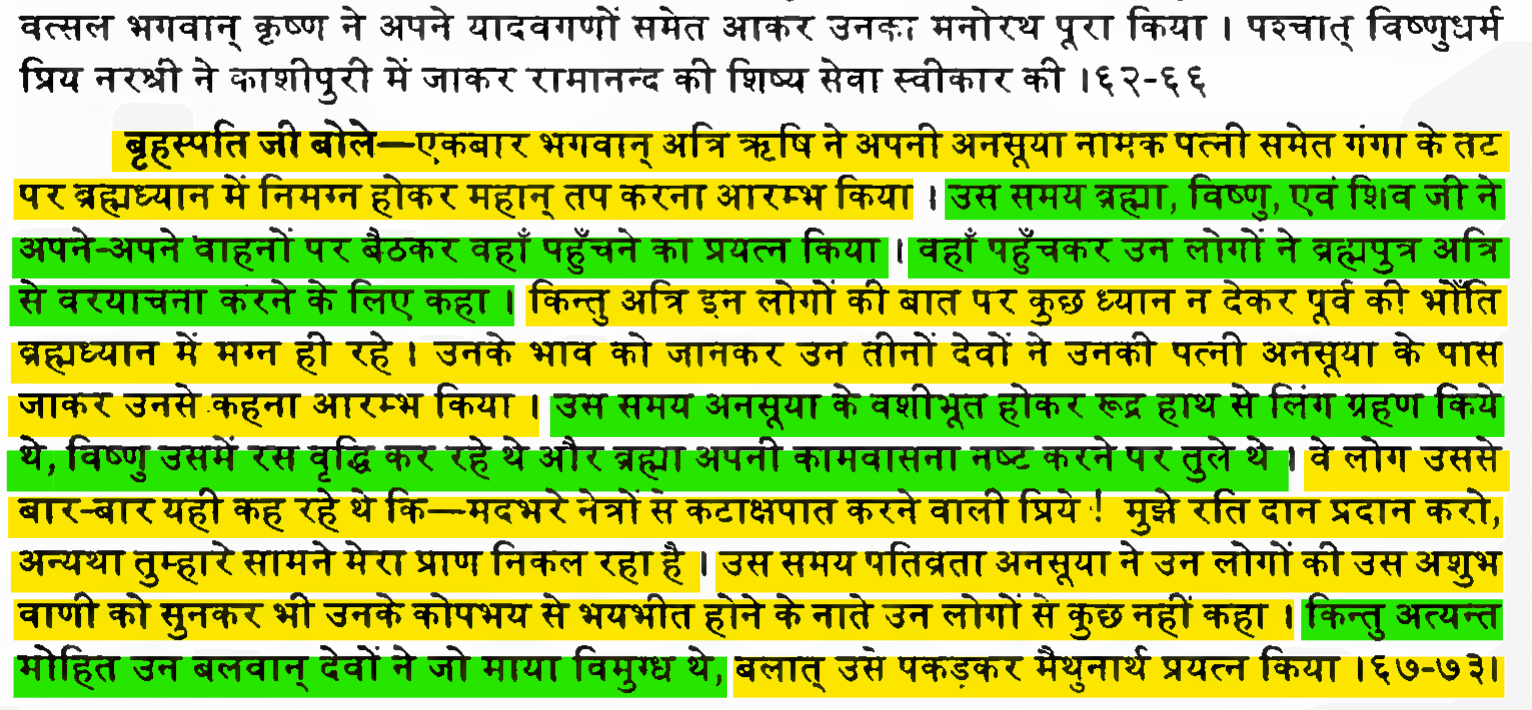
English Translation - Bhavishya Puran page 686
Brihaspati said: Once, Sage Atri, along with his wife named Anasuya, began intense penance on the banks of the river Ganga, being deeply absorbed in meditation on Brahm.
At that time, Brahma, Vishnu, and Shiva, mounting their respective vehicles, attempted to reach that place.
After arriving there, they requested Sage Atri for an audience. However, Atri paid no attention to their words and remained absorbed in Brahm-meditation as before.
Understanding his mental state, the three deities went to his wife Anasuya and began speaking to her.
At that time, having come under the influence of Anasuya, Shiva accepted his phallus with one hand, Vishnu was engaging in sensual desire toward her, and Brahma was intent on satisfying his lust.
Again and again they said to her: “O beloved with beautiful eyes that cast seductive glances! Grant us sexual pleasure, otherwise, right before you, our lives will depart.”
At that time, the chaste Anasuya, even after hearing those inauspicious words of theirs, did not say anything to them, being frightened by their improper conduct.
However, those boon-seeking gods, who were acting against righteousness and through illusion, forcefully seized her and attempted sexual intercourse.
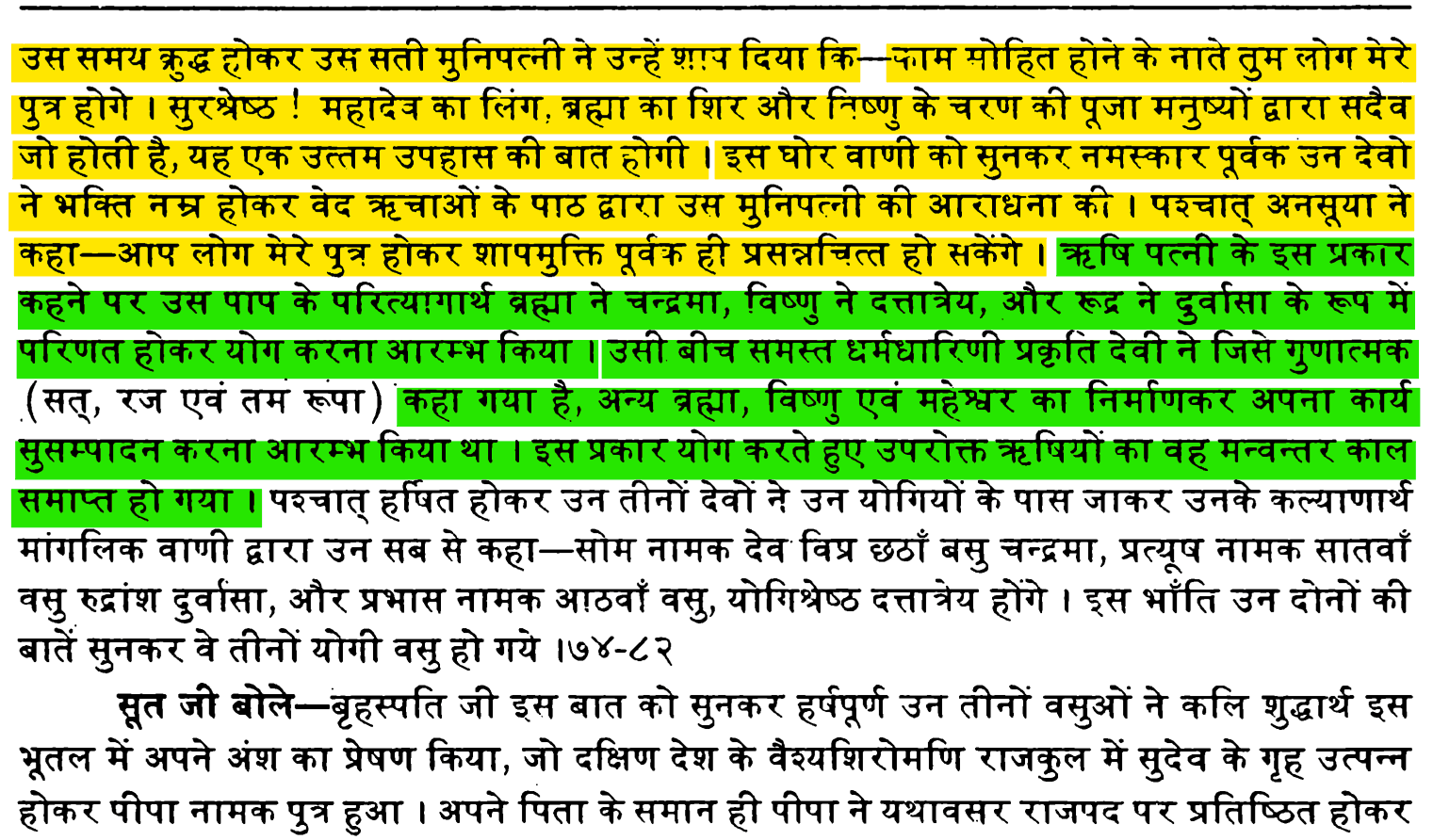
English Translation - Bhavishya Puran page 687
At that time, becoming furious, that chaste wife of the sage (Sati Anasuya) cursed them, saying—'Because you have been blinded by lust (kama-mohit), you shall become my sons. O best among the gods! The worship of Mahadeva's Linga, Brahma's head, and Vishnu's feet that is always performed by human beings will now become a matter of excellent ridicule (a grand joke).'
Hearing these terrible words, those gods bowed down respectfully and, with humble devotion, worshipped the wife of the sage by reciting Vedic hymns (Veda-richas). Thereafter, Anasuya said—'Only by becoming my sons will you achieve liberation from this curse and find happiness in your hearts.'
Upon the sage's wife speaking in this manner, to free themselves from that sin, Brahma transformed into Chandra (the Moon), Vishnu transformed into Dattatreya, and Rudra (Shiva) transformed into Durvasa, and they began practicing intense Yoga.
In the meantime, the sustainer of all righteous principles, Prakriti Devi—who is described as embodying the three primal qualities (Sattva, Rajas, and Tamas)—created another Brahma, Vishnu, and Maheshwar (Shiva), and began executing her universal administration.
While practicing Yoga in this manner, the entire Manvantara (cosmic age) of the aforementioned sages came to an end. Thereafter, being pleased, those three (newly created) gods approached the practicing yogis and, with auspicious words for their welfare, said to them all—'The deity named Soma shall be the Brahmin sixth Vasu (Chandra), Durvasa shall be the incarnation of Rudra's portion as the seventh Vasu named Pratyusha, and the supreme among yogis, Dattatreya, shall be the eighth Vasu named Prabhas.' Hearing these words in this manner, those three yogis became the Vasus. [Verses 74–82]
The Literal Text: The Illicit Seduction of Sati Anasuya
According to the verbatim text of the Bhavishya Purana, the great sage Atri was sitting on the banks of the sacred River Ganga, completely immersed in deep, unwavering meditation (Brahmadhayan). Seizing this moment of absolute isolation, the Trimurti arrived at his hermitage. Rather than acting as divine protectors, the text outlines a startling descent into earthly, primal passion:
Blinded by Delusion: Driven by fierce carnal desires and entirely overwhelmed by Maya (cosmic illusion), the three powerful gods approached Atri’s chaste wife, Anasuya.
The Demands of Lust: The text describes the gods pleading with her using passionate, inappropriate language. They explicitly begged her to grant them physical intimacy (rati-daan), claiming that their very life forces would leave their bodies if she refused.
The Physical Assault: Breaking all codes of cosmic righteousness, the text explicitly states that the powerful gods abandoned their divine stature and physically grabbed her by force to fulfill their lustful desires (balaat use pakadkar maithunarth prayatna kiya).
The Devastating Curse and the Destruction of the Deities
Despite her absolute terror at the physical aggression and spiritual wrath of the deities, Anasuya’s moral purity (Satitva) granted her immense cosmic power. Furious at their unholy speech and actions, she unleashed a devastating curse that struck directly at their divinity:
"Because you have been blinded by lust, you shall become my children. Furthermore, humans eternally praise Mahadeva's Linga, Brahma's head, and Vishnu's feet—but from now on, your forms will be ridiculed by humanity as a joke."
Upon hearing this dreadful decree, the terrified deities fell to their feet, reciting Rigvedic hymns to appease her. Anasuya softened the blow with an ultimatum: they would only find liberation from this curse by physically manifesting as her sons. Consequently, their current divine forms passed away into spiritual submission, forcing them to reincarnate under mortal conditions:
- Brahma transformed into Chandra (the Moon).
- Vishnu transformed into the mystic Dattatreya.
- Shiva (Rudra) transformed into the short-tempered sage Durvasa.
Cosmos in Chaos: Prakriti Devi (Goddess Durga) Restores the Universe
With the original Trimurti bound by the curse, diminished in stature, and entering a period of deep yogic penance as Anasuya's sons, the absolute balance of the universe was shattered. The administrative seats of Creation, Preservation, and Destruction were left completely vacant. To prevent total cosmic collapse, Prakriti Devi—the Primordial Mother Goddess Durga, embodying the three primal Gunas (Sattva, Rajas, and Tamas)—intervened.
Taking absolute control of the universe, she created an entirely new Brahma, Vishnu, and Shiva to assume the cosmic duties. The verbatim text notes that these newly manufactured deities successfully ran the universe until that entire Manvantara (cosmic age) concluded.
Hard Realities: The Deep Philosophical Conclusions
This verbatim passage from the Bhavishya Purana challenges the modern, sanitized versions of these deities, offering profound and unapologetic philosophical truths:
1. Deities Are Not Immune to Lust and Death
The narrative explicitly proves that the functional deities of the universe are subject to the same cosmic laws as humans. When placed under the intense grip of material illusion (Maya), even the entities in charge of cosmic laws can fall victim to baseline primal desires (Kama). Their subsequent submission to Anasuya's curse represents a form of spiritual and functional "death"—proving that unchecked passion leads to a downfall, regardless of spiritual status.
2. The Absolute Supremacy of the Divine Feminine (Shakti)
While the Trimurti are often viewed as self-sustaining lords, this text demonstrates their ultimate dependency. When the male triad faltered and faced destruction, it was Prakriti Devi who proved to be the ultimate, unchanging reality. She is the source from which multiple versions of Brahma, Vishnu, and Shiva can be manifested to keep existence moving, establishing her as the true supreme controller of the cosmos.
3. The Power of Human Virtue Over Divine Authority
The story elevates human righteousness (Satitva and Tapas) far above structural divine power. A mortal woman, armed purely with moral purity, successfully subdued and penalized the rulers of the three worlds. It serves as a stark reminder that cosmic laws of karma and righteousness apply equally to both man and god.
Conclusion
This raw perspective from the Bhavishya Purana serves as a testament to the immense depth and variety of ancient Puranic literature, where even the highest gods are held accountable to the unyielding laws of morality and the absolute power of Nature.
Later Puranic retellings and popular narratives often:
- Remove explicit sexual language
- Reframe the event as a “test”
- Shift blame away from the gods
- Portray Anusuya’s ordeal as divine validation rather than victimisation
However, the Bhavishya Purana’s version does not support such reinterpretations. The text itself preserves the raw moral tension and leaves the gods’ conduct exposed rather than absolved.
Ref:
Related Topics
- Meat Eating Prohibited for Seekers of Heaven - Skanda Purana
- The Equine Romance of Surya Dev: How the Twin Ashvini Kumars Were Born - Markandeya Purana
- Brahma's Infatuation towards his own Daughter - Matsya Purana
- The Legend of Brahma and Amogha: Padma Purana
- The Day Goddess Parvati Caught Shiva: The Untold Legend of Kshemankari Devi - Padma Puran
- Devi Purana
- Shiv Purana
- Markandeya Puran
- Kurma Purana
- Padma Purana
- Skanda Purana
- Brahm Purana
- Bhavishya Purana
- Brahma Vaivarta Purana
- Bhagavata Purana or Shrimad Bhagavatam
- Why Did Rama Reject Sita? Decoding Yuddha Kanda in the Valmiki Ramayana
- Wine and Meat in the Ramayana? What Valmiki Wrote About Rama and Sita
- Brahma, Vishnu and Shiva Are Mortal - Kurma Purana - The Supreme God Is Kavi (Kavir Dev)
- Origin of Shiva, Vishnu, Brahma, and the Supreme Truth - Shiv Purana
- The Story Behind Shiva’s Phallic Form (Shivling) - Shiv Purana
- Why Did Lord Brahma Lose His Fifth Head - Shiv Purana
- The Bhasmasura Episode - Shrimad Bhagavatam
- King Parikshit and the Five Abodes of Kali Yuga - Shrimad Bhagavatam
- The Ordeal of Anusuya and the Conduct of Brahma, Vishnu, Shiva - Bhavishya Purana
- Kartikeya’s Birth in the Brahm Vaivarta Purana
- The Tulsi–Vishnu Narrative - Brahma Vaivarta Purana
- How did the Universe Originate - Devi Bhagavad Purana
- The Tale of the Hidden Kshar Brahm - Devi Bhagavat Purana
- The Cosmic Battle of Madhu and Kaitabha - Devi Bhagavata Purana
- The Mystery of two Brahma, Vishnu and Shiva - Devi Bhagavata Purana
- Vishnu, Shiva, and Brahma Realize Their Dependence on Goddess Durga - Devi Bhagavata Purana
- The Divine Marriages of Brahma, Vishnu, and Shiva — Devi Bhagavata Purana
- The Real Purpose of Pilgrimage - Devi Bhagavata Purana
- Teachings of Brihaspati and Shukracharya - Devi Bhagavata Purana
- The Story of Sage Ruchi - Markandeya Purana
- The Story of Sage Markandey and Indra: A Scriptural Warning Against Temporary Heavenly Pleasures
- The Controversial Shraddha Teachings of Queen Madalasa - Markandeya Purana
- Pururava Pilgrimage - Brahm Purana
- The Controversial Feast of Lord Shiva - Padma Purana
