The Intoxicating Royal Court: When Valmiki Depicted Rama and Sita Consuming Wine and Meat
In contemporary practicing Hinduism, the concepts of Sattvik dietary purity, absolute vegetarianism, and the avoidance of alcohol are heavily championed as core spiritual standards. The popular cultural image of Sri Rama and Mata Sita is one of immaculate, ascetic purity, largely shaped by later medieval devotional literature like Sant Tulsidas’s Ramcharitmanas. However, a direct, verbatim investigation of the ancient Sanskrit source text—the Valmiki Ramayana (Uttara Kanda, Sarga 42)—reveals a highly alternative lifestyle that directly challenges modern cultural taboos.
The original text explicitly depicts the divine couple in a state of royal luxury, with Sri Rama dining on well-roasted meats and physically handing a cup of honey-wine to Sita. For modern practitioners who look down upon alcohol and meat as spiritually degrading, this scriptural passage presents a fascinating and deeply controversial reality.
Verbatim From the Text: Honey-Wine and Roasted Meats
The verses of Sarga 42 cover a peaceful era in Ayodhya following Rama's coronation, set inside the luxurious, palace-adjacent Ashoka Vatika. Far from a rigid, puritanical courtroom, Valmiki portrays a scene of sensual and royal indulgence:
सीतामादाय हस्तेन मधु मैरेयकं शुचि। पाययामास काकुत्स्थः शचीमिव पुरंदरः॥ १८½॥
- The Translation: "Just as Indra, the lord of the celestials, makes Shachi drink nectar, even so Sri Rama, the ornament of the Kakutstha lineage, took the pure honey-wine called Maireya in his own hand and made Sita drink it." (Verse 18½)
मांसानि च सुभृष्टानि फलानि विविधानि च। रामस्याभ्यवहारार्थं किंकरास्तूर्णमाहरन्॥ १९½॥
- The Translation: "Attendants quickly brought there well-roasted meats (Mamsani) and various kinds of fruits as royal delicacies for Sri Rama’s meal." (Verse 19½)
To add to the intoxication of the scene, the subsequent verses state that very beautiful, clever royal women, "under the absolute influence of the wine they drank" (Madhu-pana-janita madake vashibhuta), danced intimately near Sri Rama to entertain him (Verses 20½–21½).
The Cultural Slant: Why This Scene Explodes Modern Taboos
In mainstream Hindu discourse, consuming alcohol (Madya) and flesh (Mamsa) are classified under Tamasic or Rajasic tendencies—traits associated with ignorance or uncontrolled passion. They are strictly forbidden for Brahmins and viewed as barriers to spiritual liberation. By showing the ultimate avatar of virtue (Maryada Purushottam) actively participating in and facilitating these acts, the passage exposes several historical and theological rifts:
1. Private Marriage vs. Modern Public Piety
What makes this passage uniquely intense is the domestic intimacy. Rama does not merely tolerate Sita drinking; he affectionately serves her the wine with his own hands (likened to the king of gods, Indra, pampering his queen). The text highlights an ancient acceptance of sensory pleasure (Kama) as a valid pursuit for a married householder king.
2. The Systematic Sanitization of Later Texts
This text demonstrates why regional, medieval translations completely altered or omitted portions of the Uttara Kanda. When the Bhakti movement swept India centuries later, a meat-eating, wine-pouring Rama became a theological impossibility for poets trying to preach radical ascetic devotion. Thus, centuries of selective retelling successfully erased these verses from the public consciousness, creating a cultural shockwave whenever the original Sanskrit verses are brought to light.
The Apologetic Counter-Arguments: The Linguistic Battle
Because this passage is highly distressing to traditionalists, standard devotional commentators employ complex linguistic maneuvers to alter the literal meaning of these verses:
- The "Fruit Pulp" Argument: Some traditional apologists claim that the word Mamsani does not mean the flesh of an animal, but rather the "fleshy pulp" of a thick fruit, and that Madhu refers strictly to wild bee honey rather than an intoxicating wine.
- The Contextual Refutation: However, language scholars counter that Valmiki used the highly specific word Maireya, which is an undeniable, ancient technical term for a spiced, fermented herbal wine. Furthermore, the accompanying verses explicitly state that the court dancers were intoxicated by what they drank, destroying the argument that only non-alcoholic honey was present on the table.
A More Human, Complex Avatar
Reading this passage from the Valmiki Ramayana forces a reconsideration of ancient Hindu theology. It reveals a tradition that was historically secure enough to depict its highest moral hero enjoying wine and meat within the bounds of his royal warrior status. Far from degrading his divinity, Valmiki's unvarnished portrayal presents a multifaceted, royal view of Rama—a king who perfectly balanced his morning religious rituals with his afternoon material and marital pleasures.
Image - Valmiki Ramayan - Sarg 42, Page 792
This text is from the Uttara Kanda (The Epilogue/Final Book) of the Valmiki Ramayana, specifically from Sarga 42. This section describes a period of deep romantic bliss, luxury, and domestic harmony shared by Sri Rama and Sita in the royal pleasure groves (Ashoka Vatika) of Ayodhya after his coronation, long before the painful events of her exile. Notably, it contains direct descriptions of the royal couple consuming honey-wine (Maireya) and being entertained by celestial dancers.
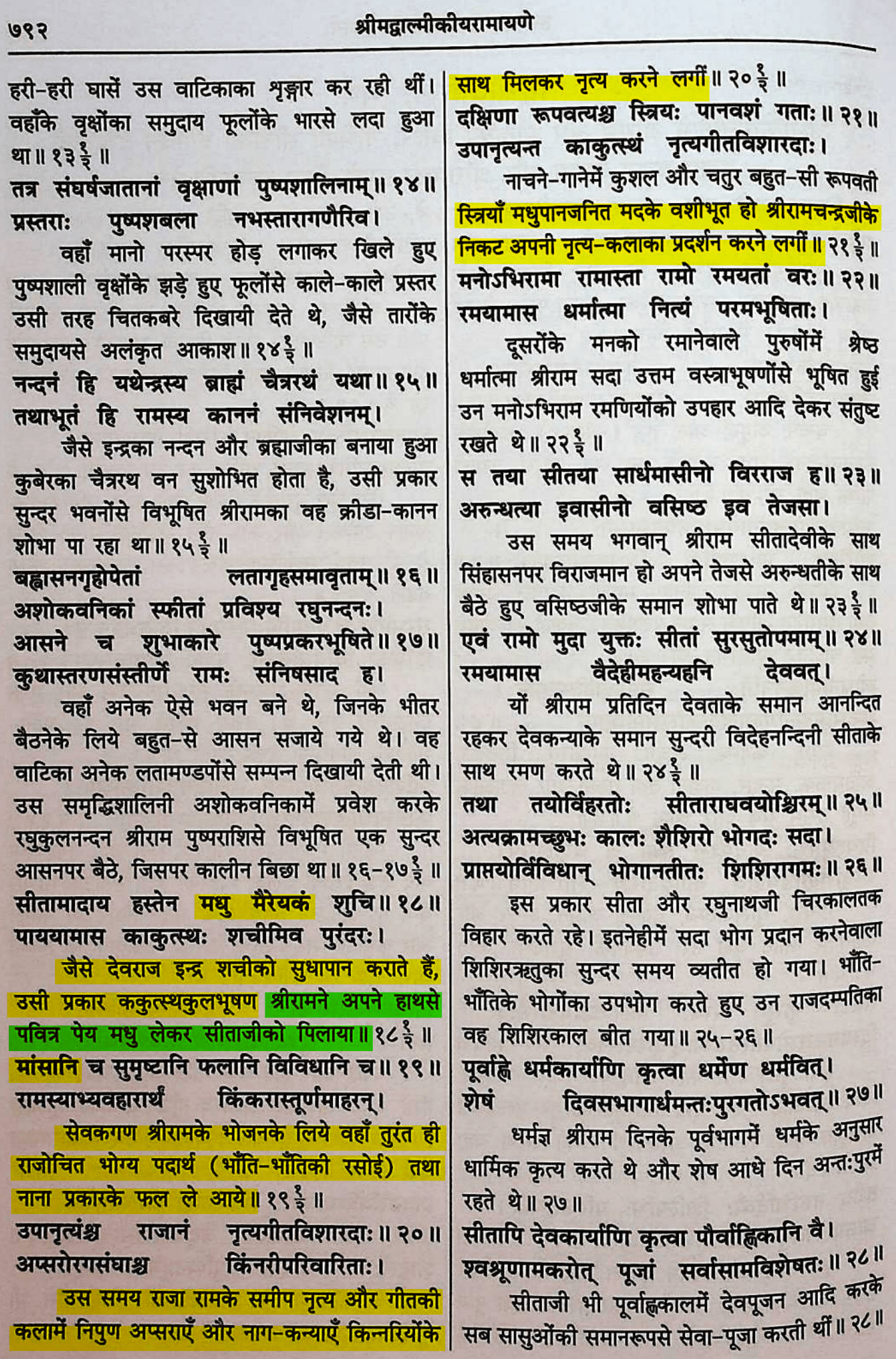
Below is the complete, direct English translation of the Sanskrit verses along with the corresponding Hindi commentary provided on page 712.
Section 1: The Beauty of the Ashoka Grove (Left Column Top)
Verse 13½–14½:
हरी-हरी घासें उस वाटिकाका शृङ्गार कर रही थीं। वहाँके वृक्षोंका समुदाय फूलोंके भारसे लदा हुआ था॥ १३½॥ तत्र सङ्घर्षजातानां वृक्षाणां पुष्पशालिनाम्॥ १४॥ प्रस्तराः पुष्पशबला नभस्तारागणैरिव।
- Hindi Translation: वहाँ मानो परस्पर होड़ लगाकर खिले हुए पुष्पशाली वृक्षोंके झड़े हुए फूलोंसे काले-काले प्रस्तर (पत्थर) उसी तरह चितकबरे दिखायी देते थे, जैसे तारोंके समुदायसे अलंकृत आकाश॥ १४½॥
- English Translation: Green grasses were adorning that garden. The clusters of trees there were heavily laden with the weight of flowers. [13½] The stones on the ground, covered with the fallen blossoms of those flowering trees that seemed to compete with one another, appeared variegated and speckled, just like the sky adorned with clusters of stars. [14½]
Verse 15½:
नन्दनं हि यथेन्द्रस्य ब्राह्मं चैत्ररथं यथा॥ १५॥ तथाभूतं हि रामस्य काननं संनिवेशनम्।
- Hindi Translation: जैसे इन्द्रका नन्दन और ब्रह्माजीका बनाया हुआ कुबेरका चैत्ररथ वन सुशोभित होता है, उसी प्रकार सुन्दर भवनोंसे विभूषित श्रीरामका वह क्रीड़ा-कानन शोभा पा रहा था॥ १५½॥
- English Translation: Just as Indra’s Nandana grove and Kubera’s Chaitraratha forest created by Brahma look beautiful, in the very same way, that pleasure-grove of Sri Rama, adorned with beautiful mansions, shone with immense splendor. [15½]
Verse 16–17½:
बहुआसनगृहोपेतं लतागृहसमावृतम्॥ १६॥ अशोकवनिकां स्फीतां प्रविश्य रघुनन्दनः। आसने च शुभाकारे पुष्पप्रकरभूषिते॥ १७॥ कुथास्तरणसंस्तीर्णे रामः संनिषसाद ह।
- Hindi Translation: वहाँ अनेक ऐसे भवन बने थे, जिनके भीतर बैठनेके लिये बहुत-से आसन सजाये गये थे। वह वाटिका अनेक लतामण्डपोंसे सम्पन्न दिखायी देती थी। उस समृद्धिशालिनी अशोकवनिकामें प्रवेश करके रघुकुलनन्दन श्रीराम पुष्पराशिसे विभूषित एक सुन्दर आसनपर बैठे, जिसपर कालीन बिछा था॥ १६–१७½॥
- English Translation: Many such mansions were built there, inside which numerous seats were arranged for sitting. That garden appeared rich with many bowers of creeping vines. Entering that prosperous Ashoka grove, Sri Rama, the joy of Raghu's race, sat down upon a beautiful seat adorned with a heap of flowers and covered with a fine carpet. [16–17½]
Section 2: The Intoxicating Drink and Royal Feast (Left Column Bottom)
Verse 18½:
सीतामादाय हस्तेन मधु मैरेयकं शुचि॥ १८॥ पाययामास काकुत्स्थः शचीमिव पुरंदरः।
- Hindi Translation: जैसे देवराज इन्द्र शचीको सुधापान कराते हैं, उसी प्रकार ककुत्स्थकुलभूषण श्रीरामने अपने हाथसे पवित्र पेय मधु ले कर सीताजीको पिलाया॥ १८½॥
- English Translation: Just as Indra, the lord of the celestials, makes Shachi drink nectar, even so Sri Rama, the ornament of the Kakutstha lineage, took the pure honey-wine called Maireya in his own hand and made Sita drink it. [18½]
Verse 19½:
मांसानि च सुभृष्टानि फलानि विविधानि च॥ १९॥ रामस्याभ्यवहारार्थं किंकरास्तूर्णमाहरन्।
- Hindi Translation: सेवकगण श्रीरामके भोजनके लिये वहाँ तुरंत ही राजोचित भोग्य पदार्थ (भाँति-भाँति की रसोई) तथा नाना प्रकारके फल ले आये॥ १९½॥
- English Translation: Attendants quickly brought there well-roasted meats and various kinds of fruits as royal delicacies for Sri Rama’s meal. [19½]
Verse 20½–21½ (Transitions to Right Column Top):
उपानृत्यंश्च राजानं नृत्यगीतविशारदाः॥ २०॥ अप्सरोरगसङ्घाश्च किंनरीपरिवारिताः। साथ मिलकर नृत्य करने लगीं॥ २०½॥ दक्षिणा रूपवत्यश्च स्त्रियः पानवशं गताः॥ २१॥ उपानृत्यन्त काकुत्स्थं नृत्यगीतविशारदाः।
- Hindi Translation: उस समय राजा रामके समीप नृत्य और गीतकी कलामें निपुण अप्सराएँ और नाग-कन्याएँ किन्नरियोंके साथ मिलकर नृत्य करने लगीं॥ २०½॥ नाचने-गानेमें कुशल और चतुर बहुत-सी रूपवती स्त्रियाँ मधुपानजनित मदके वशीभूत हो श्रीरामचन्द्रजीके निकट अपनी नृत्य-कलाका प्रदर्शन करने लगीं॥ २१½॥
- English Translation: At that time, Apsaras (celestial nymphs) and Naga-maidens, highly skilled in the arts of dance and music, along with Kinnara women, gathered and began to dance near King Rama. [20½] Many beautiful, clever women, well-versed in singing and dancing, became intoxicated under the influence of the wine and began to display their dancing skills close to Sri Ramachandra. [21½]
Section 3: The Conjugal Bliss and Daily Routine (Right Column Middle & Bottom)
Verse 22½:
मनोऽभिरामा रामास्ता रामो रमयतां वरः॥ २२॥ रमयामास धर्मात्मा नित्यं परमभूषिताः।
- Hindi Translation: दूसरोंके मनको रमानेवाले पुरुषोंमें श्रेष्ठ धर्मात्मा श्रीराम सदा उत्तम वस्त्राभूषणोंसे भूषित हुई उन मनोऽभिराम रमणियोंको उपहार आदि देकर संतुष्ट रखते थे॥ २२½॥
- English Translation: The righteous Sri Rama, the foremost among those who delight others, always kept those enchanting women—who were adorned in excellent garments and ornaments—satisfied by giving them gifts and tokens. [22½]
Verse 23½:
स तया सीतया सार्धमासीनो विरराज ह॥ २३॥ अरुन्धत्या इवासीनो वसिष्ठ इव तेजसा।
- Hindi Translation: उस समय भगवान् श्रीराम सीतादेवीके साथ सिंहासनपर विराजमान हो अपने तेजसे अरुन्धतीके साथ बैठे हुए वसिष्ठजीके समान शोभा पाते थे॥ २३½॥
- English Translation: At that time, Lord Sri Rama, seated upon the throne alongside Devi Sita, shone with his own radiance, looking exactly like the sage Vashistha seated beside Arundhati. [23½]
Verse 24½–26½:
एवं रामो मुदा युक्तः सीतां सुरसुतोपमाम्॥ २४॥ रमयामास वैदेहीमहन्यहनि देववत्। तथा तयोर्विहरतोः सीताराघवयोश्चिरम्॥ २५॥ अत्यक्रामच्छुभः कालः शैशिरो भोगदः सदा। प्रास्योर्विविधान् भोगानतीतः शिशिरागमः॥ २६॥
- Hindi Translation: यों श्रीराम प्रतिदिन देवताके समान आनन्दित रहकर देवकन्याके समान सुन्दरी विदेहनन्दिनी सीताके साथ रमण करते थे॥ २४½॥ इस प्रकार सीता और रघुनाथजी चिरकालतक विहार करते रहे। इतनेहीमें सदा भोग प्रदान करनेवाला शिशिरऋतुका सुन्दर समय व्यतीत हो गया। भाँति-भाँतिके भोगोंका उपभोग करते हुए उन राजदम्पतिका वह शिशिरकाल बीत गया॥ २५–२६½॥
- English Translation: In this manner, everyday Sri Rama, rejoicing like a god, delighted in the company of Vaidehi (Sita), who was as beautiful as a daughter of the gods. [24½] Thus, Sita and Raghunatha continued to enjoy their pastimes for a long time. In the meantime, the beautiful season of Shishira (late winter), which always yields worldly pleasures, passed away. Enjoying various kinds of luxuries, that royal couple spent that entire winter season. [25–26½]
Verse 27½:
पूर्वाह्णे धर्मकार्याणि कृत्वा धर्मेण धर्मवित्॥ २७॥ शेषं दिवसभागार्धमन्तःपुरगतोऽभवत्।
- Hindi Translation: धर्मज्ञ श्रीराम दिनके पूर्वभागमें (सुबह) धर्मके अनुसार धार्मिक कृत्य करते थे और शेष आधे दिन अन्तःपुरमें रहते थे॥ २७½॥
- English Translation: Sri Rama, the knower of righteousness, performed his religious and state duties in the forenoon (morning) according to Dharma, and spent the remaining half of the day inside the inner palace chambers (Antahpura). [27½]
Verse 28½:
सीतापि देवकार्याणि कृत्वा पूर्वाह्निकाणि वै॥ २८॥ श्वश्रूणामकरोत् पूजां सर्वांसामविशेषतः।
- Hindi Translation: सीताजी भी पूर्वाह्नकालमें देवपूजन आदि करके सब सासुओंकी समानरूपसे सेवा-पूजा करती थीं॥ २८½॥
- English Translation: Sita too, having completed her morning prayers and worship of the deities in the forenoon, would serve and pay reverence to all her mothers-in-law equally without any distinction. [28½]
Ref:
Related Topics
- Meat Eating Prohibited for Seekers of Heaven - Skanda Purana
- The Equine Romance of Surya Dev: How the Twin Ashvini Kumars Were Born - Markandeya Purana
- Brahma's Infatuation towards his own Daughter - Matsya Purana
- The Legend of Brahma and Amogha: Padma Purana
- The Day Goddess Parvati Caught Shiva: The Untold Legend of Kshemankari Devi - Padma Puran
- Devi Purana
- Shiv Purana
- Markandeya Puran
- Kurma Purana
- Padma Purana
- Skanda Purana
- Brahm Purana
- Bhavishya Purana
- Brahma Vaivarta Purana
- Bhagavata Purana or Shrimad Bhagavatam
- Why Did Rama Reject Sita? Decoding Yuddha Kanda in the Valmiki Ramayana
- Wine and Meat in the Ramayana? What Valmiki Wrote About Rama and Sita
- Brahma, Vishnu and Shiva Are Mortal - Kurma Purana - The Supreme God Is Kavi (Kavir Dev)
- Origin of Shiva, Vishnu, Brahma, and the Supreme Truth - Shiv Purana
- The Story Behind Shiva’s Phallic Form (Shivling) - Shiv Purana
- Why Did Lord Brahma Lose His Fifth Head - Shiv Purana
- The Bhasmasura Episode - Shrimad Bhagavatam
- King Parikshit and the Five Abodes of Kali Yuga - Shrimad Bhagavatam
- The Ordeal of Anusuya and the Conduct of Brahma, Vishnu, Shiva - Bhavishya Purana
- Kartikeya’s Birth in the Brahm Vaivarta Purana
- The Tulsi–Vishnu Narrative - Brahma Vaivarta Purana
- How did the Universe Originate - Devi Bhagavad Purana
- The Tale of the Hidden Kshar Brahm - Devi Bhagavat Purana
- The Cosmic Battle of Madhu and Kaitabha - Devi Bhagavata Purana
- The Mystery of two Brahma, Vishnu and Shiva - Devi Bhagavata Purana
- Vishnu, Shiva, and Brahma Realize Their Dependence on Goddess Durga - Devi Bhagavata Purana
- The Divine Marriages of Brahma, Vishnu, and Shiva — Devi Bhagavata Purana
- The Real Purpose of Pilgrimage - Devi Bhagavata Purana
- Teachings of Brihaspati and Shukracharya - Devi Bhagavata Purana
- The Story of Sage Ruchi - Markandeya Purana
- The Story of Sage Markandey and Indra: A Scriptural Warning Against Temporary Heavenly Pleasures
- The Controversial Shraddha Teachings of Queen Madalasa - Markandeya Purana
- Pururava Pilgrimage - Brahm Purana
- The Controversial Feast of Lord Shiva - Padma Purana
