Why Does Lord Brahma Have Four Faces? The Fascinating Story From Matsya Purana
Have you ever wondered why Lord Brahma, the creator deity in Hinduism, is uniquely depicted with multiple heads while other major gods usually have one? While most devotees know that Lord Brahma has four faces representing the four Vedas, the scriptural origin story behind his physical form is far more dramatic and deeply symbolic. According to ancient texts like the Matsya Purana (मत्स्यपुराण), the manifestation of Brahma's multiple heads was born out of an intense cosmic drama involving his own creation, Shatarupa which caused his decline secondary to getting infatuated to his own daughter thus leading to instant destruction of good virtues earned through intense penance.
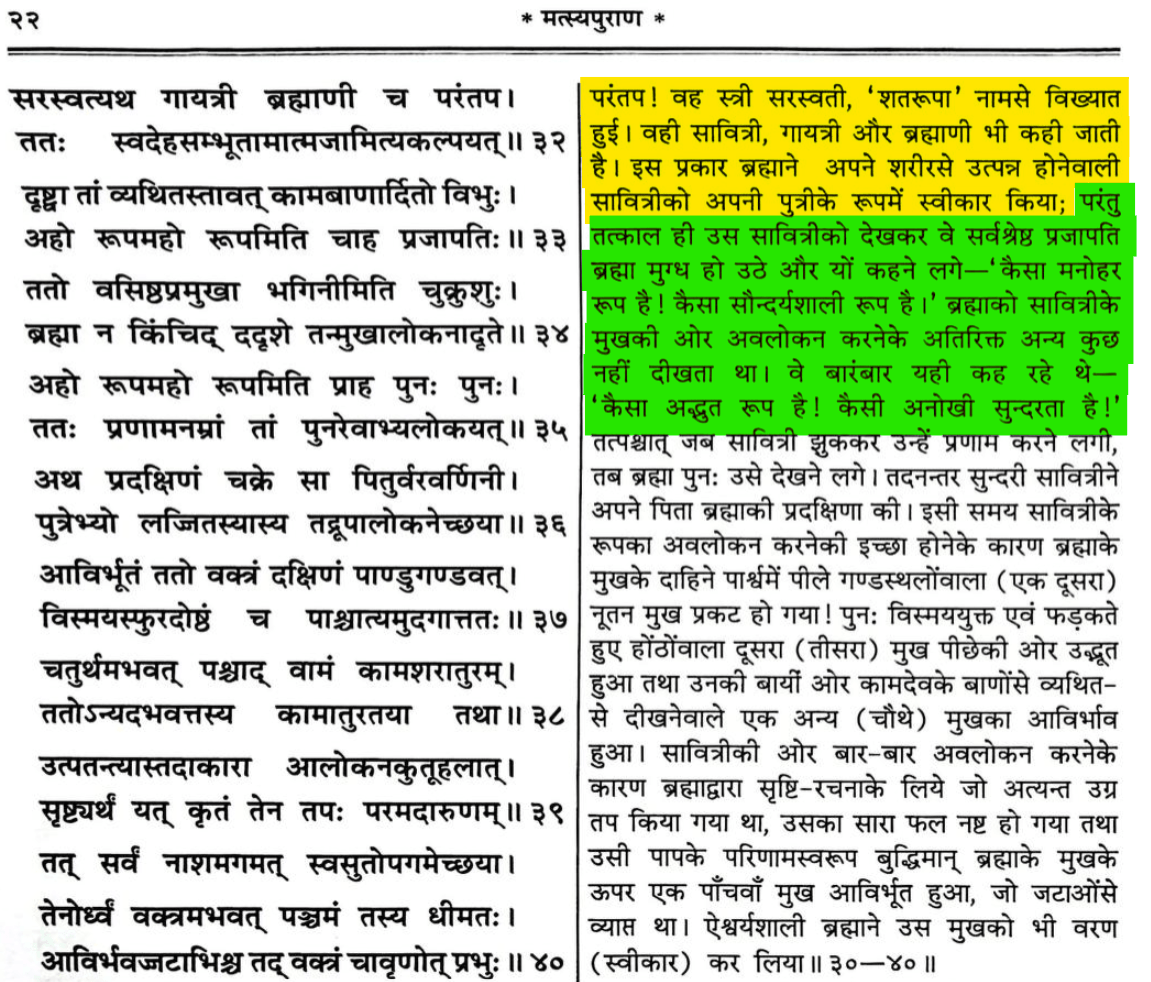
The passage from the Matsya Purana (मत्स्यपुराण), chapter 3, verses 32 to 40, describes a famous Puranic story regarding Brahma, his creation of Shatarupa (also called Savitri, Gayatri, and Brahmani), his intense infatuation with her beauty, and how he developed multiple faces to look at her as she circumambulated (walked around) him.
Here is the authentic story directly translated and decoded from Chapter 3 of the Matsya Purana.
The Creation of Shatarupa (The Woman of a Hundred Forms)
The narrative begins just after Lord Brahma initiates the creation of the universe. To aid in the process of cosmic generation, Brahma manifested a female form from his own divine body. As detailed in the Matsya Purana, this supreme feminine energy was known by several names:
- Shatarupa (She of a hundred beautiful forms)
- Saraswati (The goddess of wisdom)
- Savitri & Gayatri (The embodiments of sacred hymns)
- Brahmani (The female energy of Brahma)
Because she emerged directly from his body, Brahma initially accepted her as his daughter. However, her radiant celestial beauty instantly captivated the creator. Struck by the arrows of Kamadeva (the deity of desire and love), Brahma became entirely entranced.
How Brahma Grew Four (and Five) Heads
The text describes an intense moments of infatuation where Brahma could look at nothing else. He repeatedly exclaimed, "What a magnificent form! What extraordinary beauty!" Seeing their father gripped by passion, Brahma’s mind-born sons (such as the great Sage Vasistha) were deeply disturbed. They openly protested, reminding him that Shatarupa was like a sister to them and a daughter to him. But Brahma was too overwhelmed by desire to listen. To show her respect, Shatarupa bowed down to Brahma and began to perform a Pradakshina (ritual circumambulation or walking around a deity/elder in a clockwise direction). What happened next explains the physical manifestation of Brahma's multiple faces:
- The Second Face (Right): As Shatarupa moved to his right side to walk around him, Brahma wished to keep staring at her without physically turning his body. Instantly, a second face with glowing features manifested on the right side of his head.
- The Third Face (Back): As she walked behind him, a third face immediately emerged from the back of his head to maintain his gaze.
- The Fourth Face (Left): As she moved to his left side, a fourth face, visibly afflicted by the arrows of desire, appeared on his left.
- The Fifth Face (Top): Driven by curiosity and a desire to escape his intense gaze, Shatarupa flew high up into the sky. Looking upward, a fifth head—covered in matted ascetic hair (Jata)—sprouted on the very top of Brahma's head.
Matsya Purana - hindi text
परंतप! वह स्त्री सरस्वती, 'शतरूपा' नामसे विख्यात हुई। वही सावित्री, गायत्री और ब्रह्माणी भी कही जाती है। इस प्रकार ब्रह्माने अपने शरीरसे उत्पन्न होनेवाली सावित्रीको अपनी पुत्रीके रूपमें स्वीकार किया; परंतु तत्काल ही उस सावित्रीको देखकर वे सर्वश्रेष्ठ प्रजापति ब्रह्मा मुग्ध हो उठे और यों कहने लगे—'कैसा मनोहर रूप है! कैसा सौन्दर्यशाली रूप है!' ब्रह्माको सावित्रीके मुखकी ओर अवलोकन करनेके अतिरिक्त अन्य कुछ नहीं दीखता था। वे बारंबार यही कह रहे थे—'कैसा अद्भुत रूप है! कैसी अनोखी सुन्दरता है!'
तत्पश्चात् जब सावित्री झुककर उन्हें प्रणाम करने लगी, तब ब्रह्मा पुनः उसे देखने लगे। तदनन्तर सुन्दरी सावित्रीने अपने पिता ब्रह्माकी प्रदक्षिणा की। इसी समय सावित्रीके रूपका अवलोकन करनेकी इच्छा होनेके कारण ब्रह्माके मुखके दाहिने पार्श्वमें पीले गण्डस्थलोंवाला (एक दूसरा) नूतन मुख प्रकट हो गया! पुनः विस्मययुक्त एवं फड़कते हुए होंठोंवाला दूसरा (तीसरा) मुख पीछेकी ओर उद्भूत हुआ तथा उनकी बायीं ओर कामदेवके बाणोंसे व्यथित-से दीखनेवाले एक अन्य (चौथे) मुखका आविर्भाव हुआ।
सावित्रीकी ओर बार-बार अवलोकन करनेके कारण ब्रह्माद्वारा सृष्टि-रचनाके लिये जो अत्यन्त उग्र तप किया गया था, उसका सारा फल नष्ट हो गया तथा उसी पापके परिणामस्वरूप बुद्धिमान् ब्रह्माके मुखके ऊपर एक पाँचवाँ मुख आविर्भूत हुआ, जो जटाओंसे व्याप्त था। ऐश्वर्यशाली ब्रह्माने उस मुखको भी वरण (स्वीकार) कर लिया ॥ ३०-४० ॥
The Spiritual Consequence: Why It Matters
The Matsya Purana ends this specific passage with a sobering warning about the consequences of uncontrolled desire. Because Brahma allowed himself to be consumed by infatuation for his own creation, the entire spiritual merit (Tapas) he had accumulated through rigorous penance to create the universe was instantly destroyed. The text refers to this loss of spiritual power as the direct karmic consequence (Paap) of his obsession.
Why Does Brahma Only Have Four Faces Today?
Though the Matsya Purana describes the birth of the fifth head, popular Hindu iconography only depicts Brahma with four faces. According to subsequent chapters in the Puranas and Shiva traditions, Lord Shiva later cut off Brahma’s fifth head to punish his hubris and inappropriate attachment, leaving him with the four faces we see today, which look toward the four cardinal directions (North, South, East, and West).
Summary of Iconography
| Face Location | Symbolic Meaning in Scripture |
|---|---|
| Front (East) | Represents the Rigveda, orientation towards creation |
| Right (South) | Represents the Yajurveda, orientation towards preservation/rituals |
| Back (West) | Represents the Samaveda, orientation towards cosmic music/cycles |
| Left (North) | Represents the Atharvaveda, orientation towards esoteric knowledge |
The story from the Matsya Purana serves as a profound allegorical reminder that even the creator of 3 lokas (Brahma) is subject to the immutable laws of Karma and cosmic order (Dharma).
The Secret Union and the Birth of Manu
The cosmic drama did not stop at physical transformation. As the Matsya Purana details in verses 41-45, Brahma waited for a moment of absolute isolation. Once his mind-born sons and sages departed to start creating life across the cosmos, Brahma was left alone with Shatarupa.
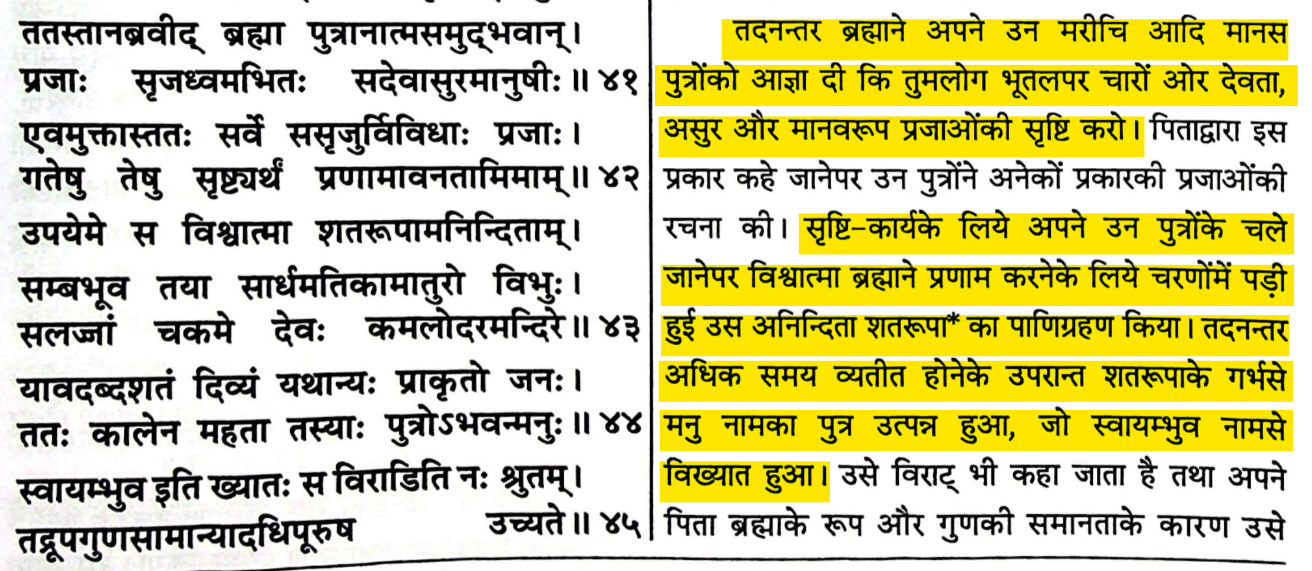
While she was bowed down at his feet in a gesture of filial respect, Brahma formally took her hand in marriage. Driven by an all-consuming passion, he lived with her as a husband. From this highly controversial union—born entirely out of the creator's lack of self-restraint—Shatarupa eventually gave birth to a son named Svayambhuva Manu (also known as Virat). Ironically, in the Puranic tradition, it is this very Manu who becomes the first man and the progenitor of all human civilization.
Conclusion
The tale of Brahma and Shatrupa raises three critical plot points:
- Calculated Secrecy: Brahma didn't just act blindly; he waited until his moralizing mind-born sons (the sages who actively protested his lust) left the area to begin creation elsewhere. The moment he was left alone with his daughter, he seized her.
- Consummation of Incest: The phrase "पाणिग्रहण किया" (took her hand in marriage) indicates that Brahma formalized this taboo union. The text notes that she was initially salajjam (bashful/ashamed) and bowing at his feet, yet he united with her anyway.
- The Birth of Humanity's Ancestor: From this highly controversial, incestuous union between father and daughter, Svayambhuva Manu (the first man/progenitor of humanity in Hindu mythology) was born.
Ultimately, the story from the Matsya Purana pulls no punches in depicting the vulnerability of the creator deity. Driven by raw, uncontrolled passion, Lord Brahma succumbed to intense sexual desire for his own daughter, Shatarupa. Despite his supreme role as the architect of the universe, he was entirely powerless against the arrows of Kamadeva. This narrative serves as a stark reminder that by allowing lust to override sacred boundaries, Brahma lost the spiritual merit of his immense penance (Tapas).
Ref:
Related Topics
- Meat Eating Prohibited for Seekers of Heaven - Skanda Purana
- The Equine Romance of Surya Dev: How the Twin Ashvini Kumars Were Born - Markandeya Purana
- Brahma's Infatuation towards his own Daughter - Matsya Purana
- The Legend of Brahma and Amogha: Padma Purana
- The Day Goddess Parvati Caught Shiva: The Untold Legend of Kshemankari Devi - Padma Puran
- Devi Purana
- Shiv Purana
- Markandeya Puran
- Kurma Purana
- Padma Purana
- Skanda Purana
- Brahm Purana
- Bhavishya Purana
- Brahma Vaivarta Purana
- Bhagavata Purana or Shrimad Bhagavatam
- Why Did Rama Reject Sita? Decoding Yuddha Kanda in the Valmiki Ramayana
- Wine and Meat in the Ramayana? What Valmiki Wrote About Rama and Sita
- Brahma, Vishnu and Shiva Are Mortal - Kurma Purana - The Supreme God Is Kavi (Kavir Dev)
- Origin of Shiva, Vishnu, Brahma, and the Supreme Truth - Shiv Purana
- The Story Behind Shiva’s Phallic Form (Shivling) - Shiv Purana
- Why Did Lord Brahma Lose His Fifth Head - Shiv Purana
- The Bhasmasura Episode - Shrimad Bhagavatam
- King Parikshit and the Five Abodes of Kali Yuga - Shrimad Bhagavatam
- The Ordeal of Anusuya and the Conduct of Brahma, Vishnu, Shiva - Bhavishya Purana
- Kartikeya’s Birth in the Brahm Vaivarta Purana
- The Tulsi–Vishnu Narrative - Brahma Vaivarta Purana
- How did the Universe Originate - Devi Bhagavad Purana
- The Tale of the Hidden Kshar Brahm - Devi Bhagavat Purana
- The Cosmic Battle of Madhu and Kaitabha - Devi Bhagavata Purana
- The Mystery of two Brahma, Vishnu and Shiva - Devi Bhagavata Purana
- Vishnu, Shiva, and Brahma Realize Their Dependence on Goddess Durga - Devi Bhagavata Purana
- The Divine Marriages of Brahma, Vishnu, and Shiva — Devi Bhagavata Purana
- The Real Purpose of Pilgrimage - Devi Bhagavata Purana
- Teachings of Brihaspati and Shukracharya - Devi Bhagavata Purana
- The Story of Sage Ruchi - Markandeya Purana
- The Story of Sage Markandey and Indra: A Scriptural Warning Against Temporary Heavenly Pleasures
- The Controversial Shraddha Teachings of Queen Madalasa - Markandeya Purana
- Pururava Pilgrimage - Brahm Purana
- The Controversial Feast of Lord Shiva - Padma Purana
